Showing posts with label George Bush. Show all posts

29 June 2008

Are we about to go to war against Iran?

Wow, is this really going to happen .... what is GWB doing?

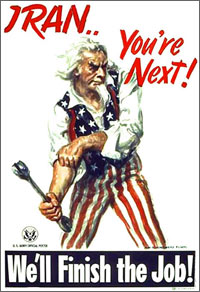
Report: U.S. "Preparing the Battlefield in Iran"

WASHINGTON (CNN) -- The Bush administration has launched a "significant escalation" of covert operations in Iran, sending U.S. commandos to spy on the country's nuclear facilities and undermine the Islamic republic's government, journalist Seymour Hersh said Sunday.

An Iranian flag flies outside the building containing the reactor of Bushehr nuclear power plant, south of Tehran.

An Iranian flag flies outside the building containing the reactor of Bushehr nuclear power plant, south of Tehran.

White House, CIA and State Department officials declined comment on Hersh's report, which appears in this week's issue of The New Yorker.

Hersh told CNN's "Late Edition with Wolf Blitzer" that Congress has authorized up to $400 million to fund the secret campaign, which involves U.S. special operations troops and Iranian dissidents.

President Bush and Vice President Dick Cheney have rejected findings from U.S. intelligence agencies that Iran has halted a clandestine effort to build a nuclear bomb and "do not want to leave Iran in place with a nuclear program," Hersh said.

"They believe that their mission is to make sure that before they get out of office next year, either Iran is attacked or it stops its weapons program," Hersh said.

The new article, "Preparing the Battlefield," is the latest in a series of articles accusing the Bush administration of preparing for war with Iran.

He based the report on accounts from current and former military, intelligence, and congressional sources. Watch Hersh discuss what he says are the administration's plans for Iran Video

"As usual with his quarterly pieces, we'll decline to comment," White House spokesman Gordon Johndroe told CNN.

24 June 2008

A person is a person through other persons


We say in our African idiom, ‘A person is a person through other persons.’ The solitary human being is a contradiction in terms. I need you in order to be me as you need me in order to be you. We are caught up in a delicate network of interconnectedness. I have gifts that you don’t, and you have gifts I don’t–voila! We are made different so that we may know our need of one another. The completely self-sufficient human being is subhuman. Thus diversity, difference is of the essence of who we are.

Desmond Tutu, An address at University of Toronto’s Convocation Hall, February 16, 2000

29 May 2008

"war should only be waged when necessary"

What I do know is that war should only be waged when necessary, and the Iraq war was not necessary.

- Former White House press secretary Scott McClellan, in his new book, What Happened: Inside the Bush White House and Washington's Culture of Deception, in which he describes the administration as "manipulating sources of public opinion" and "downplaying the major reason for going to war." (Source: The Washington Post)

12 May 2008

Obama supporter marries George Bush's Daughter


Well, actually it was the minister who officiated at Jenna Bush's wedding who is the Obama supporter ... but, the headline above is more interesting...


From "GetReligion Blog"...

No question about it, this is the picture of the day. Here’s the lede from the New York Times, taking the details right down to the one that will have tongues wagging a bit inside the Beltway:

President Bush’s daughter Jenna Welch Bush on Saturday married Henry Chase Hager, a graduate student and son of a former Virginia lieutenant governor, before 200 relatives and close family friends here, the White House confirmed. . . .

Although the Bush family kept up a strict zone of privacy around the events, the tiny town of Crawford made merry on its own. Souvenir shops hung banners wishing Ms. Bush, 26, and Mr. Hager, 30, well. Jenna-and-Henry coffee mugs, mouse pads and coasters flew off the shelves. One shop served wedding cake.

On Saturday afternoon, the Hager family hosted wedding guests at a barbecue in Salado. The wedding, which began at 7:30 p.m., took place on the Bush ranch, before a white limestone altar erected next to a man-made lake. The Rev. Kirbyjon Caldwell of Windsor Village United Methodist Church in Houston officiated at the ceremony. Mr. Caldwell, a longtime religious adviser to Mr. Bush, has endorsed Senator Barack Obama.

As you would expect, every major news story mentions this final detail — so much so that it is almost impossible to find a Google search combination that actually gets you any meaningful details about Caldwell’s involvement. You just get that one political note.

However, over at Beliefnet.com there is an interview with Caldwell — a rather traditionalist United Methodist of evangelical leanings, in the doctrinal sense of that word — in which he talks about his decision to back Obama:

One, I think he’s just a solid man. He’s a solid, spiritual man, and I have a great deal of respect for him as an individual.

Number two, when he initially announced, they said, “Well, he will be a symbolic candidate. He has no chance of winning.” And then he began to attract, you know, crowds of 20, 30, 40,000. Then they’d say, “Well, he may attract twenty, thirty thousand folk at a time, but he won’t be able to raise any money.” And then he started raising a ton of money. . . . Then, they said, “Well, he’s not black enough.” Well, clearly he is. Then they said, “He’s too black.” Well, that’s ridiculous. Then they said, “Well, you know, he doesn’t like white folk because his pastor says whatever.” And I think folks forget his mother was white, for goodness sake. The grandmother of his children are white. I mean it just — that’s just a ridiculous argument.

Then, they said, “Well, he’s Muslim.” And he’s confessed his faith — I would say that he’s more of a Christian than some folk who claim to be Christian, because he didn’t grow up in a Christian house. . . . He had to declare his faith separate and distinct from his — from the house that he grew up in.

Now what you will not find, in this interview, is how Caldwell squares his endorsement with any of the moral and cultural issues involved. In other words, with the actual religious content of Obama’s faith and that of the United Church of Christ. Again, the basic, foundational questions are missing as the interview rushes on to the strictly political.

I would have been interested in hearing what Caldwell has to say...

me too!!

14 April 2008

Will Ferrell as George Bush on Global Warmings

So funny! This has been out for awhile, but its worth another click...

Some quotes to warm you up....(so to speak)

"Think back to Biblical times ... it was hot back then, too, why do you think Adam and Eve were naked?"

"Adam and Eve drove an Excursion"

"let's talk about something that really matters, like keeping steroids out of T-Ball"

"I think the Polar Ice Caps suck; Who cares about a place where a bunch of penguins can have an orgy"


Anything behind the Benedict/White House Dinner Story?

From Reuters

Anything behind the Benedict/White House Dinner Story


Posted by: Tom Heneghan
Tags: FaithWorld, , , ,

President Bush at a White House dinner for U.S. governors, 25 Feb 2008/Jonathan ErnstJust before leaving for Washington to cover Pope Benedict’s U.S. visit, I got an interesting comment from a FaithWorld reader on another post about the trip:

Pope Benedict will skip White House dinner (in his honor!) with Bush. This is the incredibly significant detail of Pope’s visit. Why Mr. Henegan (sic) is so shy on this significance? Finally, the highest clerical authorities started behave like adults and demonstrate true feeling to the monster in the White House. The Christian communities around the world condemn the anti-Christian American president, though the American evangelicals are still behind and still cannot see the anti-Christ monstrosities emanating from the current administration.

I thought this was quite imaginative and said so. Pope Benedict does not like big fancy dinners and usually spends quiet evenings on his trips dining and conversing with the local cardinal, archbishop or nuncio. There was never any question of him changing this routine. There’s not much use scrutinising his agenda to see if he has time after all to pop over to the White House.

On arriving here, I’ve now heard or seen the”pope-no-show” story on the radio, on television and in today’s Washington Post (”Guess who’s not coming to dinner?“). These reports simply noted the facts, without the imaginative slant of the above comment or the explanation in response.

Is there another story behind this that political reporters are overlooking? What is the purpose of throwing a big party at the White House if the guest of honour can’t make it? It must be to please the people who attend. And who’s attending? White House spokesman Scott Stanzel said they would be “leaders from the Catholic community from all over the country who are in town for that visit.”

Is there some election year/Catholic vote angle in this?

Pope John Paul II serves homeless people at the Vatican, 4 Jan 1987/VaticanP.S. I don’t know how long it’s been since the Vatican has held a big state dinner worthy of the many opulent rooms it has where it could hold one. They must have done it a lot centuries ago, but recently? I searched through our photo database looking for a shot of a pope proposing a toast for a visiting king or showing a president his seat at a long table groaning with golden cutlery and fine china. All I found, though, was a black-and-white shot from 1987 when the late Pope John Paul invited homeless people in for a meal and served some himself.

12 April 2008

Pope Won't Attend White House Dinner in His Honor

Hmmmmm, interesting...?

From the Dallas Morning News Religion Blog:
8:36 AM Sat, Apr 12, 2008 |

By Bruce Tomaso

President Bush will greet Pope Benedict XVI at Andrews Air Force Base when the pontiff arrives in Washington on Tuesday. The president will also host a formal greeting the next morning on the South Lawn of the White House. And the two will confer in the Oval Office.

But Benedict has no plans to attend a dinner that President Bush and First Lady Laura Bush are hosting in his honor Wedesday night.

Here's the story by Deb Reichmann of the Associated Press.

"U.S. Catholic leaders from around the nation will attend," she writes. "The menu will offer Bavarian-style food in recognition of the pope's German heritage. It's even the pope's 81st birthday. But he won't be there."

The Vatican strongly opposed the U.S.-led invasion of Iraq. And the church opposes capital punishment. No state in the union executed more convicts than Texas when Bush was governor.

At a press briefing Friday in Crawford, Texas, White House spokesman Scott Stanzel offered no explanation for the pope's decision to skip the dinner -- a dinner being thrown in his honor. Here's an excerpt:

Q. Scott, just to clarify, for the Pope's visit to the White House, you said that now there's a dinner in the East Room in honor of the Pope.

MR. STANZEL: Yes.

Q Will the Pope actually be attending that dinner?

MR. STANZEL: I don't believe so, no.

Q Okay, thank you. ...


Q I'm sorry, the Pope doesn't attend a dinner in his honor?

MR. STANZEL: No.

Q How does that work?

MR. STANZEL: He doesn't come into the building.

Q But then it's not a dinner for the Pope, is it?

MR. STANZEL: It's in honor of his visit. There will be leaders from the Catholic community from all over the country who are in town for that visit.

Q Is there a reason the Pope doesn't attend the dinner?

MR. STANZEL: I don't know. I don't have the full extent of his schedule.

A spokesperson for the first lady said the pope is "on a very ambitious official schedule" during his time in Washington, and plans to meet with U.S. bishops on the night of the dinner.

But surely if Benedict wanted to, he could find time to break bread with the president of the United States.

No?

23 March 2008

Grim milestone: 4,000 U.S. service employees dead in Iraq war

On Easter, the US service death toll in the Iraq War hit 4000. What responsibility does the church have to raise issues of war and peace, of torture and punishment, of politics and power? Was Jesus "political" or not? These issues also are swirling around questions of race and class especially brought up by the Rev. Jeremiah Wright's preaching. Some assert that we should "leave politics out of the pulpit," while others believe we should "preach prophetically," and "speak truth to power," in our preaching. These issues are vitally important to engage at this point in our nation's history, and working through the conflicting thoughts about "Church" and "power" and "politics" are vitally important. What is the Church's role? Hmmmm..


From CNN....read the whole article HERE.

Grim milestone: 4,000 U.S. service employees dead in Iraq war

BAGHDAD, Iraq (CNN) -- Four U.S. soldiers died in a roadside bombing in Iraq on Sunday, military officials reported, bringing the American toll in the 5-year-old war to the grim milestone of 4,000 deaths. Eight of those killed were civilians working for the Pentagon.

art.iraq.attack2.ap.jpg

Troops emerge from a bunker after receiving the "all clear" Sunday following a truck bombing in Mosul.

Click to view previous image
1 of 3
Click to view next image

The four were killed when their vehicle was hit by an improvised explosive device while patrolling a neighborhood in southern Baghdad, the U.S. military headquarters in Iraq reported Sunday night. A fifth soldier was wounded in the attack, which took place about 10 a.m. (3 a.m. ET).

The U.S. milestone comes just days after Americans marked the fifth anniversary of the start of the war.

Meanwhile, estimates of the Iraqi death toll range from about 80,000 to the hundreds of thousands, with another 2 million forced to leave the country and 2.5 million people displaced within Iraq, according to the U.N. High Commissioner for Refugees.

President Bush ordered U.S. troops into Iraq on March 19, 2003, after months of warnings that then-Iraqi leader Saddam Hussein was concealing stockpiles of chemical and biological weapons and efforts to build a nuclear bomb.

U.N. weapons inspectors found no sign of banned weapons before the invasion, and the CIA later concluded that Iraq had dismantled its weapons programs in the 1990s.

Hussein's government fell in early April 2003, and Iraq's new government executed him in December 2006.

The news of the 4,000 mark came on the same day that Iraq's national security adviser urged Americans to be patient with the progress of the war, contending that it is "well worth fighting" because it has implications about "global terror."


Read the rest HERE.

25 October 2007

Waking Up to War with Iran? (from Brian McLaren)

Are we ready to take to the streets if the Bush Administration puts us into war in Iran?
Or, are we ready to enlist?
Should we be more afraid of our own government than of Iran?
What should Christians do in this context of protracted war?
Brian McLaren has challenged us in his blog entry on the "God's Politics Blog" that begins to address these questions.

Will we have ears to hear?


Waking Up to War with Iran (by Brian McLaren)

I am afraid, but not for the reasons our government is telling me to be afraid. I am afraid that I may wake up one morning soon to discover that our government has launched a preemptive attack on Iran. While our government is issuing national orange alerts about "them," I wonder whether we Christians should be issuing global orange alerts about our own government.

I am disgusted, concerned, appalled, and furious about the current saber-rattling of our government - so reminiscent of the buildup to the invasion of Iraq. My feelings intensify in many of our presidential candidates' forums, where each candidate seems to be in a hissing contest, declaring that he or she is the loudest hisser against terrorism - as if the only danger in the world is posed by an evil "them" and not by evil resident within us. Our Congress' bipartisan vote last month, which labeled the Iranian Revolutionary Guard Corps a terrorist organization, seems to me to be handing our president a "go to war free" card, another rather frightening development.

Meanwhile, our media are becoming an echo chamber of fear: after all, fear keeps people tuned in, which means better ratings, and thus more advertising income. Fear pays - economically and politically - but sadly, we haven't reached the point yet of fearing fear itself and what it may do if it keeps accelerating.

On top of these fears, I suspect that many of my fellow Christians will, in the name of God and Jesus and Christianity and the Bible, support and justify a preemptive war on Iran before and after it happens - no matter how unprovoked, no matter how brutal, and no matter how foolish and costly, both financially and morally. Forgetting even the traditional Christian criteria for just war, and forgetting the falsified "intelligence" used to justify our last preemptive war, we Christians in the U.S., I fear, will once again be high on credulity and low on scrutiny - all too eager to believe what our government tells us to legitimize a pre-emptive attack and feed our growing fears. We Christians who cannot follow this path into another war must ask ourselves two kinds of questions:

  1. What will we do if we wake up and find our government has attacked Iran while we were sleeping? What actions - public and private - would be appropriate?
  2. What can we do now to decrease the possibility of that occurring? What will we wish we would have done in the weeks and months before the morning after?
Follow along with upcoming Brian McLaren blog entries HERE.

18 October 2007

Stephen Colbert: Running for President!? ;)


Stephen Colbert has "guest written" Maureen Dowd's New York Times opinion letter this week, and,...he's running for president (but only in South Carolina)...he cracks me up:

I Am an Op-Ed Columnist (And So Can You!)

Surprised to see my byline here, aren’t you? I would be too, if I read The New York Times. But I don’t. So I’ll just have to take your word that this was published. Frankly, I prefer emoticons to the written word, and if you disagree :(

I’d like to thank Maureen Dowd for permitting/begging me to write her column today. As I type this, she’s watching from an overstuffed divan, petting her prize Abyssinian and sipping a Dirty Cosmotinijito. Which reminds me: Before I get started, I have to take care of one other bit of business:

Bad things are happening in countries you shouldn’t have to think about. It’s all George Bush’s fault, the vice president is Satan, and God is gay.

There. Now I’ve written Frank Rich’s column too.

So why I am writing Miss Dowd’s column today? Simple. Because I believe the 2008 election, unlike all previous elections, is important. And a lot of Americans feel confused about the current crop of presidential candidates.

For instance, Hillary Clinton. I can’t remember if I’m supposed to be scared of her so Democrats will think they should nominate her when she’s actually easy to beat, or if I’m supposed to be scared of her because she’s legitimately scary.

Or Rudy Giuliani. I can’t remember if I’m supposed to support him because he’s the one who can beat Hillary if she gets nominated, or if I’m supposed to support him because he’s legitimately scary.

And Fred Thompson. In my opinion “Law & Order” never sufficiently explained why the Manhattan D.A. had an accent like an Appalachian catfish wrestler.

Well, suddenly an option is looming on the horizon. And I don’t mean Al Gore (though he’s a world-class loomer). First of all, I don’t think Nobel Prizes should go to people I was seated next to at the Emmys. Second, winning the Nobel Prize does not automatically qualify you to be commander in chief. I think George Bush has proved definitively that to be president, you don’t need to care about science, literature or peace.

While my hat is not presently in the ring, I should also point out that it is not on my head. So where’s that hat? (Hint: John McCain was seen passing one at a gas station to fuel up the Straight Talk Express.)

Others point to my new bestseller, “I Am America (And So Can You!)” noting that many candidates test the waters with a book first. Just look at Barack Obama, John Edwards or O. J. Simpson.

Look at the moral guidance I offer. On faith: “After Jesus was born, the Old Testament basically became a way for Bible publishers to keep their word count up.” On gender: “The sooner we accept the basic differences between men and women, the sooner we can stop arguing about it and start having sex.” On race: “While skin and race are often synonymous, skin cleansing is good, race cleansing is bad.” On the elderly: “They look like lizards.”

Our nation is at a Fork in the Road. Some say we should go Left; some say go Right. I say, “Doesn’t this thing have a reverse gear?” Let’s back this country up to a time before there were forks in the road — or even roads. Or forks, for that matter. I want to return to a simpler America where we ate our meat off the end of a sharpened stick.

Let me regurgitate: I know why you want me to run, and I hear your clamor. I share Americans’ nostalgia for an era when you not only could tell a man by the cut of his jib, but the jib industry hadn’t yet fled to Guangdong. And I don’t intend to tease you for weeks the way Newt Gingrich did, saying that if his supporters raised $30 million, he would run for president. I would run for 15 million. Cash.

Nevertheless, I am not ready to announce yet — even though it’s clear that the voters are desperate for a white, male, middle-aged, Jesus-trumpeting alternative.

What do I offer? Hope for the common man. Because I am not the Anointed or the Inevitable. I am just an Average Joe like you — if you have a TV show.

11 July 2007

What it means to be a Christian after George Bush...article

I just returned to NYC from a few days away at Cape Cod, where I read a wonderful and challenging piece in the Boston Globe by Charles Marsh, a University of Virginia Professor of Religion and Scholar at the Project on Lived Theology (who I plan to look up when I get back to Virginia). Writing from an evangelical point of view and framework, he offers an important and interesting perspective on our Commander in Chief and on Christianity and God and Country in our present time.

What it means to be a Christian after George W. Bush

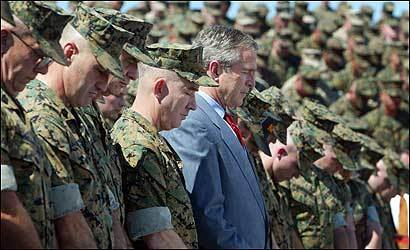
President Bush joins marines in prayer at Camp Lejeune, N.C., on April 3, 2003. Accordiing to a Pew Charitable Trusts poll that month, 87 percent of white American evangelicals supported the president's decision to invade Iraq.
President Bush joins marines in prayer at Camp Lejeune, N.C., on April 3, 2003. Accordiing to a Pew Charitable Trusts poll that month, 87 percent of white American evangelicals supported the president's decision to invade Iraq. (Pablo Martinez Monsivais/AP)

If God's on our side, He'll stop the next war
-- Bob Dylan

EARLY ONE SUNDAY morning in the spring of 2003, in the quiet hours before services would begin at the evangelical church where I worship in Charlottesville, Virginia, I opened files compiled by my research assistant and read the statements drafted by Christians around the world in opposition to the American invasion of Iraq.

The experience was profoundly moving and shaming: From Pentecostals in Brazil to the Christian Councils of Ghana, from the Greek Orthodox Patriarchate of Antioch and All the East to the Anglican Bishop of Jerusalem, from Pope John Paul II to the The Waldensian Reformed Church of Italy and the Christian Conference of Asia, the voices of our brothers and sisters in the global ecumenical church spoke in unison.

Why did American evangelicals not pause for a moment in the rush to war to consider the near-unanimous disapproval of the global Christian community? The worldwide Christian opposition seems to me the most neglected story related to the religious debate about Iraq: Despite approval for the president's decision to go to war by 87 percent of white evangelicals in April 2003, according to a Pew Charitable Trusts poll, almost every Christian leader in the world (and almost every nonevangelical leader in the United States) voiced opposition to the war.


In their enthusiastic support of the White House's decision to invade Iraq, evangelicals in the United States practiced an ecumenical isolationism that mirrored the prevailing political trend. Rush Limbaugh may have pleased his "dittoheads" in mocking the dissenting pastors, archbishops, bishops, and church leaders who stuck their noses into our nation's foreign policy, but the people in the United States who call themselves Christian must organize their priorities and values on a different standard than partisan loyalty.

These past six years have been transformative in the religious history of the United States. It is arguably the passing of the evangelical moment -- if not the end of evangelicalism's cultural and political relevance, then certainly the loss of its theological credibility. Conservative evangelical elites, in exchange for political access and power, have ransacked the faith and trivialized its convictions. It is as though these Christians consider themselves to be recipients of a special revelation, as if God has whispered eternal secrets in their ears and summoned them to world-historic leadership in the present and future.

One thing, however, is clear: Any hope for renewal depends on the willingness to reach out to our brothers and sisters abroad. We must reshape the way we live in the global Christian community and form a deeper link to the human family and to life. To do this, we must begin by learning to be quieter, and by reaffirming the simple fact that our faith transcends political loyalty or nationhood.

. . .

In a German concentration camp in 1944, the theologian, pastor, and Christian martyr Dietrich Bonhoeffer pondered the future of the church in Germany as it lay in the ruins of its fatal allegiance to Hitler.

"The time of words is over," he wrote. "Our being a Christian today will be limited to two things: prayer and righteous action."

Bonhoeffer, who had actively opposed the Nazis since the passage of the Aryan Laws of 1933 and was executed in April 1945, believed that the church had so compromised its witness to Jesus Christ that it was now incapable of "taking the word of reconciliation and redemption to mankind and the world." The misuse of the language of faith had humiliated the Word; any hope for renewal would need to begin with the humble recognition that God was most certainly tired of all our talk.

It is time to give Bonhoeffer's meditations a new hearing. With many other Christians in the United States and many more abroad, I have watched with horror in recent years as the name of Jesus has been used to serve national ambitions and justify war. Forgetting the difference between discipleship and partisanship, and with complete indifference to the wisdom and insights of the Christian tradition, we have recast the faith according to our cultural preferences and baptized our prejudices, along with our will-to-power, in the shallow waters of civic piety.

By the time American troops began bombing Baghdad before sunrise on March 20, 2003, the collective effort of the evangelical elites had sanctified the president's decision and encouraged the laity to believe that the war was God's will for the nation. Evangelicals preached for the war, prayed for the war, sang for the war, and offered God's blessings on the war.

Sometime after Operation Iraqi Freedom began, I made a remarkable discovery. I had gone to one of my local Christian bookstores to find a Bible for my goddaughter. On a whim, I also decided to look for a Holy Spirit lapel pin, in the symbolic shape of a dove, the kind that had always been easy to find in the display case in the front. Many people in my church and in the places where I traveled had been wearing the American flag on their lapel for months now. It seemed like a pretty good time for Christians to put the Spirit back on.

But the doves were nowhere in sight. In the place near the front where I once would have found them, I was greeted instead by a full assortment of patriotic accessories -- red-white-and-blue ties, bandanas, buttons, handkerchiefs, "I support our troops" ribbons, "God Bless America" gear, and an extraordinary cross and flag button with the two images interlocked. I felt slightly panicked by the new arrangement. I asked the clerk behind the counter where the doves had gone. The man's response was jarring, although the remark might well be remembered as an apt theological summation of our present religious age. "They're in the back with the other discounted items," he said, nodding in that direction.

I have thought of this visit to the local Christian bookstore many times in the past several years. I remember the outrage I felt when I saw a photograph in Time magazine during the 2004 presidential election of Christian Coalition activists in Ohio. Two men, both white, and both identified as Coalition members, are holding two crosses aloft. The crosses upon closer inspection appear to be made of balloons twisted together. Across the beam-section of one of the crosses was the "Bush-Cheney" logo, and alongside the president's name was the image of an American flag. In the second cross, the president's name appeared in full at the places where Jesus's hands were nailed.

. . .

Like Bonhoeffer, I fear that the gospel has been humiliated in our time. But if this has happened, it is not because the message -- the good news that God loves us unconditionally in Jesus Christ, that we are freed and forgiven in God's amazing grace -- has changed. Nor is it due to the machinations of secularists, or because the post-Enlightenment world has dispensed with the hypothesis of God. The Christian faith has not only endured modernity and post-modernity, but flourished in its new settings.

The gospel has been humiliated because too many American Christians have decided that there are more important things to talk about. We would rather talk about our country, our values, our troops, and our way of life; and although we might think we are paying tribute to God when we speak of these other things, we are only flattering ourselves.

If only holiness were measured by the volume of our incessant chatter, we would be universally praised as the most holy nation on earth. But in our fretful, theatrical piety, we have come to mistake noisiness for holiness, and we have presumed to know, with a clarity and certitude that not even the angels dared claim, the divine will for the world. We have organized our needs with the confidence that God is on our side, now and always, whether we feed the poor or corral them into ghettos.

To a nation filled with intense religious fervor, the Hebrew prophet Amos said: You are not the holy people you imagine yourselves to be. Though the land is filled with festivals and assemblies, with songs and melodies, and with so much pious talk, these are not sounds and sights that are pleasing to the Lord. "Take away from me the noise of your congregations," Amos says, "you who have turned justice into poison."

Psalm 46 tells us, "Be still and know that I am God." Dietrich Bonhoeffer, in his classic work on Christian community, "Life Together," spoke of a silence "before the Word." He affirmed the wisdom of the Psalmist, and spoke of a listening silence that brings "clarification, purification, and concentration upon the essential thing."

After all the talk and the noise, it is time for Christians in the United States to enter a season of quietness, being still, and learning to wait on God (perhaps for the first time).

Bonhoeffer wrote "Life Together" during the years he directed an illegal seminary in the North German village of Finkenwalde. The school's mission was training pastors in the Confessing Church, a reform movement that opposed the nazified German Evangelical Church. Bonhoeffer had served in the Abwehr, the Nazi counterintelligence agency, as a double agent -- helping Jewish families escape to Switzerland and organizing a coup attempt against the Nazi regime -- and he participated in several assassination attempts on Hitler. For Bonhoeffer, being still in a time of enormous historical and ecclesial crisis was no invitation to idleness or indifference; rather, it was a call to discernment and responsible action.

. . .

Indeed, there are times when silence is an admonition fraught with danger. Martin Luther King Jr. warned of the "appalling silence of the good people" and those who turned their faces from suffering and oppression. But Dr. King also knew that careful and respectful speech was born of honest discernment of God's moral demands for the present age -- a discernment that begins in humility and quiet introspection.

I came of age in the American South in the 1960s, and the moral values shared by most families in the churches of my childhood were deeply interwoven with our culture's hold on white supremacy. The vigilant and quite often neurotic defense we made of the Southern Way of Life blinded us not only to the sufferings of African-Americans -- the victims of our collective self-righteousness -- but also to our spiritual arrogance and group pride. We believed that our conception of Christianity and our cherished family values were the most wholesome and pure the world had ever known. Inside this serene delusion, we presumed ourselves to be paragons of virtue, although we rarely lifted a finger to help anyone but our own.

It was unsettling to learn, sometime in my adolescence, that the moral values I inherited as a white Southerner were not the marks of true Christian piety.

When Jesus spoke of the family, he had in mind the new community of God. "Who are my mother and my brothers?" he said one day upon hearing that his family was asking for him. "Here are my mother and my brothers!" Jesus said, pointing to the people gathered around him, who marveled at his words. "Whoever does the will of God is my brother and sister and mother." Jesus knew that loyalty to the Kingdom of Heaven would often require the renunciation of family traditions, habits, culture, and custom.

Today, in the national debate on faith and politics, there are signs of hope as an emerging generation of Christian leaders holds out the promise of a more comprehensively just and moral account of faith than the narrow agendas of the Christian right. In particular, the success of Sojourners magazine editor Jim Wallis's 2005 book, "God's Politics," introduced many Americans to a vibrant culture of progressive Christianity ready to exert its growing influence over national politics and mobilize the churches around global poverty and AIDS relief.

And there are other encouraging signs: Criticisms of torture and detention practices of the US military by prominent Christian conservatives have been symbolically powerful moments. The emerging environmental consciousness among an increasing number of evangelical leaders and laity signals a more holistic social mission.

Even so, as welcome as these developments are, no explicitly partisan movement -- left or right -- to reclaim the soul of politics can reckon successfully with the grave effects of the Christian saturation of the American public square. Unless conditioned by clear and public confession of our support of the immoral and catastrophic war in Iraq, and our complicity in the humiliation of the Word, these efforts will lack coherence and a vital center.

Franklin Graham, the evangelist (and son of Billy Graham), boasted that the American invasion of Iraq opens up exciting new opportunities for missions to non-Christian Arabs. This is not what the Hebrew or Christian prophets meant by righteousness and discipleship. In fact, the grotesque notion that preemptive war and the destruction of innocent life pave the way for the preaching of the Christian message strikes me as a mockery and a betrayal.

But if Franklin Graham speaks truthfully of the Christian faith and its mission in the world -- as many evangelicals seem to believe -- then we should have none of it. Rather, we should join the ranks of righteous unbelievers and big-hearted humanists who rage against cruelty and oppression with the intensity of people who live fully in this world. I am certain that it would be better for Christians to stand in solidarity with compassionate atheists and agnostics, firmly resolved against injustice and cruelty, than to sing "Amazing Grace" with the heroic masses who cannot tell the difference between the cross and the flag.

Charles Marsh is professor of religion and director of the Project on Lived Theology at the University of Virginia. This essay is adapted from his new book, "Wayward Christian Soldiers: Freeing the Gospel from Political Captivity" (Oxford).