Showing posts with label Rev. Jeremiah Wright. Show all posts

28 April 2008

Wright Ex-Factor (by Diana Butler Bass)
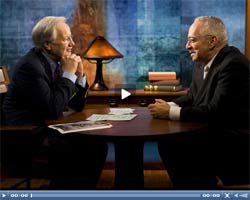
Wright Ex-Factor (by Diana Butler Bass)

Over the last several days, I watched Rev. Jeremiah Wright in discussions of faith, theology, history, and culture on television. The three-plus hours I devoted to PBS and CNN amounted to some of the most sophisticated and thoughtful programming on American culture and racial issues that any news station has offered in recent years. And, for those who really listened to Rev. Wright, he moved from being a political liability in the current presidential campaign to demonstrating why he is one of the nation's most compelling spokespersons of the African-American community and of progressive Christianity.

On Friday, Bill Moyers interviewed Wright in an hour-long conversation. (Watch it here.) On Sunday, Wright preached at an NAACP fundraiser in Detroit that attracted 10,000 people. (Watch parts 1 [intro], 2, 3, 4, 5, and 6.) Finally, on Monday morning, Wright addressed a packed National Press Club in Washington, D.C. However different the venues, a surprisingly common thread wound through all three speeches -- that a realistic understanding of history forms the spiritual basis of hope and healing.

In the Moyers interview, Wright admitted that one of the major influences on his ministry was the august historian Martin E. Marty of the University of Chicago (a white Lutheran and a true gentleman scholar), who challenged his students to relate the "faith preached in our churches" to the "world in which our church members leave at the benediction." He then quoted African-American historian Carter G. Woodson, saying that black Americans had been—and one can argue, by inference, Anglo-Americans as well—"miseducated."

I suspect that both Woodson and Marty share the perception that Americans suffer from "miseducation" regarding history. This "miseducation" means looking to the glorious parts of history and not to its despair, of having an incomplete picture—only a "piece of the story"—regarding the past. Bad history leaves out the bits that make us cringe, doubt ourselves, or question our morality. Leaving out the uncomfortable parts may reinforce cherished views, but it lacks the power of internal critique or self-correction.

Realistic history includes the good and the amoral, the profound and the profane. It gives us the ability to understand the fullness of human experience and learn from mistakes and sin. A robust vision of the past, Wright stated, enables Christians "not to leave that world and pretend that we are now in some sort of fantasy land, as Martin Marty called it, but to serve a God who comes into history on the side of the oppressed."

The God of history is also, as Wright reminded his audience on Sunday, "a God of diversity." ...

Read the rest HERE.

19 March 2008

Diana Butler Bass on Rev. Jeremiah Wright

In the God's Politics blog, Diana Butler Bass wrote this thoughtful (and provocative, judging by the comments) essay on Reverend Jeremiah Wright's comments. I found her thoughts helpful and inspired me to take another look at the tradition of Black preaching in America. It also may be helpful for all of us, and especially white Americans to take a good look at the Black Liberation Theologian, James Cone, and the full body of his work. Race in America is a huge issue, and a challenging one and an important one to consider and engage with the best of our minds and hearts.

Read Diana Butler Bass's entire article HERE.

Putting Rev. Wright's Preaching in Perspective (by Diana Butler Bass)

The current media flap over the Rev. Jeremiah Wright, Barack Obama's former pastor, strikes me as nothing short of strange. Anyone who attends church on a regular basis knows how frequently congregants disagree with their ministers. To sit in a pew is not necessarily assent to a message preached on a particular day. Being a church member is not some sort of mindless cult, where individuals believe every word preached. Rather, being a church member means being part of a community of faith—a gathered people, always diverse and sometimes at odds, who constitute Christ's body in the world.

But the attack on Rev. Wright reveals something beyond ignorance of basic dynamics of Christian community. It demonstrates the level of misunderstanding that still divides white and black Christians in the United States. Many white people find the traditions of African-American preaching offensive, especially when it comes to politics.

I know because I am one of those white people. My first sustained encounter with African-American preaching came in graduate school about twenty years ago. I had been assigned as a teaching assistant to a course in Black Church Studies. The placement surprised me, since I had no background in the subject. But the professor assured me that "anyone with experience teaching American religion" would be able to handle the load.

The subject matter was not, as the professor indicated, difficult. The emotional content, however, was. To prepare, I had to read literally thousands of pages of black preaching and theology covering the entire scope of American history. While the particulars of preaching changed through time, one thing did not. Throughout the entire corpus, black Christian leaders leveled a devastating critique against their white brothers and sisters—accusing white Christians of maintaining "ease in Zion" while allowing black people to suffer injustice and oppression.

Typical of the form used by black preachers is Frederick Douglass' address, "What to the Slave is the Fourth of July?" first delivered on July 5, 1852. The address, a political sermon, forcefully attacks white culture. "Fellow-citizens," Douglass proclaims, "above your national, tumultuous joy, I hear the mournful wails of millions! Whose chains, heavy and grievous yesterday, are, today, rendered more intolerable by the jubilee shouts that reach them." He goes on to calls American conduct "hideous and revolting" and accuses white Christians of trampling upon and disregarding both the constitution and the Bible. He concluded his sermon with the words, "For revolting barbarity and shameless hypocrisy, America reigns without a rival."

This was very hard to take. I confess: nearly everything I read that semester pained and angered me. But four months of listening to voices that I wanted to reject made me different. I began to hear the power of the critique. I came to appreciate the prophetic nature of black preaching. I recognized that these voices emerged from a very distinct historical experience. And I admired the narrative interplay between the Bible and social justice. Over time, they taught me to hear the Gospel from an angular perspective—the angle of slaves, freed blacks, of those who feared lynching, of those who longed for Africa, those who could not attend good schools. From them, I learned that liberation through Jesus was a powerful thing. And that white Americans really did need to repent when it came to race.

Read Diana Butler Bass's entire article HERE.