Showing posts with label Rowan Wiliams. Show all posts

16 March 2012

Rowan Williams to step down in 2012


Rowan Williams will step down as Archbishop of Canterbury at the end of 2012 to become head of Magdalene College at Cambridge.

Lambeth Palace has a news release. An extract:

"It has been an immense privilege to serve as Archbishop of Canterbury over the past decade, and moving on has not been an easy decision. During the time remaining there is much to do, and I ask your prayers and support in this period and beyond. I am abidingly grateful to all those friends and colleagues who have so generously supported Jane and myself in these years, and all the many diverse parishes and communities in the Church of England and the wider Anglican Communion that have brought vision, hope and excitement to my own ministry. I look forward, with that same support and inspiration, to continuing to serve the Church’s mission and witness as best I can in the years ahead."

Dr Williams will continue to carry out all the duties and responsibilities of the Archbishop of Canterbury, both for the Church of England and the Anglican Communion, until the end of the year.
The Crown Nominations Commission will consider in due course the selection of a successor.


HERE are some of the posts that I have had about Rowan Williams

01 November 2011

Rowan Williams on All Saints


In its original Latin the Apostles' Creed announces belief in the communio sanctorum; and this could mean one of two things - or maybe both. It could be 'the sharing between holy people' or it could mean 'the sharing of holy things'. Now when the New Testament, especially St Paul, talks about 'holy people', it doesn't mean quite what we might mean by 'saint', it isn't offering a sort of verdict on a lot of spectacularly good lives. Christian people are 'holy' simply because they have been adopted by God into relationship, into that family relationship expressed in saying 'Our Father'. So the 'sharing between holy people' isn't some kind of club for the spiritually gifted; it's simply the relationship that holds together those who recognize and express their adoption by God. And so this sharing becomes tangible and visible when Christians are together just breathing the air of Christ, making real in words and actions who they are in relation to Jesus. The 'communion' that is meant here is what becomes visible when Christians are simply saying who they are.

And what does this involve? The Church is the community of those who have been 'immersed' in Jesus' life, overwhelmed by it. Those who are baptized have disappeared under the surface of Christ's love and reappeared as different people. The waters close over their heads, and then, like the old world rising out of watery chaos in the first chapter of the Bible, out comes a new world. So when the Church baptizes people, it says what it is and what sort of life its people live. Baptism is an event in which the 'sharing between holy people' comes to light and we see what the Church really is, a community in which people are constantly being brought into new life by being given a new relationship with God and each other.

It is also the community of those who are invited to eat with Jesus. Just as, in his earthly life, Jesus expressed his promise to create a new people of God by sharing meals with unlikely people, just as, after the resurrection, he shares food with his disciples as he re-calls them to their task, so it is with the whole Church. We are in the Church because we have been invited, not because we have earned our place. And so when the Church gathers to eat and drink with Jesus in Holy Communion, the Church once again says who and what it is. In baptism and Holy Communion, the nature of the Church is laid bare for us. What is the Church? It is simply those who have been immersed in, soaked in the life of Jesus, and who have been invited to eat with him and pray to the Father with him.

~ Rowan Williams, Tokens of Trust (2007)

23 March 2008

Archbishop's Easter Day Sermon


Archbishop's Easter Day Sermon

Sunday 23 March 2008

Given at Canterbury Cathedral

'The last enemy to be overcome is death' (I Cor 15.26)

Your hair and your nails may keep growing for a while after you die; but nothing else does. Death is when growing stops - the routine ways in which your body repairs itself and grows fresh tissue, and the ways in which the mind and heart stop developing. We know the suffering that is caused when the mind and heart have already apparently stopped responding even before physical death - the agonizing spectacle of vegetative states or dementia. That's why people sometimes speak of these conditions as death-in-life. Signs of life are signs of response and development, and when they're not obviously there, we don't know what sort of life is really present.

So too we talk of the death of a relationship when nothing moves it forward; and we say that individuals or whole cultures are in some sense dead when they seem to be producing nothing fresh; they've lost the skill of responding and can only repeat, like the unhappy person suffering from some sorts of dementia. We fear dementia because we fear being trapped in sameness, repetition; we fear the death of love and imagination; we fear death itself because it is the end of all change. And we know that it is inescapable.

Recognising that this is so, that all the processes we value because they enlarge and enrich us will one day simply stop, is hard but it is part of growing up. Artists, scientists and psychoanalysts have in different ways warned against the dangerous illusion of thinking we are immortal. Maturity lies in accepting the truth - and then making the most of every moment of sensation so that our response is as deep and wholehearted as may be. 'This thou perceiv'st, which makes thy love more strong, / To love that well which thou must leave ere long', as Shakespeare has it at the end of one of his most memorable sonnets (no.73).

Yet here comes the Easter gospel, apparently determined to upset this stoical maturity and to promise us just that eternal life we are urged to leave behind as a childish fantasy. Death will be 'overcome', 'swallowed up in victory'. (I Cor 15.54) Is the Christian gospel just a version of that popular but problematic passage sometimes read at funerals, beginning 'Death is nothing at all' and talking of it as just 'slipping into the next room'?

That's not quite the tone of what St Paul or any of the other New Testament writers is saying - nor of some of the ancient hymns and prayers of the Church in this season. 'Death and life have contended in that combat stupendous', says one early mediaeval hymn (the Sequence of Easter Sunday); and the whole idea of a battle between life and death in the events of Christ's death and resurrection doesn't suggest an event that is 'nothing at all'. Death takes quite bit of overcoming; there's a struggle involved here. And Jesus as he faces death seems to take it with utter seriousness, acknowledging terror and shrinking from it in his desperate prayer in Gethsemane. Easter may tell us that death is conquered, but it doesn't tell us that there was never any contest.

Perhaps that's the clue. Easter is not about denying death, and the resurrection doesn't make the nightmare death on the cross unreal. Death is exactly what the artists and scientists and psychoanalysts say: it is a full stop to human growth and response, it is night falling on everything we value or understand or hope for. Fear is natural, and so is grief at the death of another (Jesus, remember, shed tears for the death of a friend). Don't attempt to avoid it or deny its seriousness. On the contrary, keep it in view; remind yourself of it. When the tradition of the Church proposes that you think daily about death and prepare for it, it isn't being morbid but realistic: get used to it and learn to live with the fear. And meanwhile - Shakespeare was being entirely Christian in this respect - get used to loving and valuing things and persons irrespective of the fact that they won't be there for ever. Love them now, and what you would want to do for them, do now. 'Night is coming when no-one can work', says Jesus. (John 9.4)

So what does it mean to say that, despite all this, death is 'defeated'? When death happens and growing stops, there are no more plans, no more hope of control: for the believer, there is only God left. Just as at the very beginning of creation, there is God, and there is the possibility that God has brought into being by his loving will. When death has done all it can do, God remains untouched and his will is the loving and generating will that it eternally is. When we look at death, we look at something that can destroy anything in our universe - but not God, its maker and redeemer. And if we accept that we shall die and all our hopes and schemes fall into the dark, we do so knowing that God is unchanged. So to die is to fall into the hands of the living God.

That is why the effort to keep death daily before us is a source of life and hope. It is to commend ourselves every day into God's hands, trusting that he is eternally a loving creator, in whom there is no darkness at all, as the New Testament says. (I John 1.5) And when we let ourselves go into God's hands, we do so confident that he is free to do what he wills with us - and that what he wills for us is life. The Easter story is not about how Jesus survived death or how the spirit of Jesus outlasted his mortal frame or whatever; it is about a person going down into darkness and the dissolving of all things and being called again out of that nothingness. Easter Day, as so many have said, is the first day of creation all over again - or, as some have put it, the eighth day of the week, the unimaginable extra that is assured by the fact that God's creative word is never stifled or silenced.

Celebrating Easter is celebrating the creator - celebrating the God whose self-giving purpose is never cancelled and who is always free to go on giving himself to those he has called. And resurrection for us is that renewed call: when we have fallen silent, when we no longer have any freedom to respond or develop, God's word comes to us again and we live. (II Cor 5.17) We can't really imagine it; it isn't just a continuation of our present life in slightly different circumstances but a new world. Yet all that God has seen and worked with in this life is brought into his presence once more and he renews his relationship with it all, spirit and body.

That is the overcoming of death - made clear to us in the only way it could be made clear, by the historical, tangible recreation of the life of Jesus, still recognizably who he always was, yet changed in ways we can't grasp in their fullness. Death is allowed to do its worst in him - not only in the form of physical pain and final extinction, but in the terror and desolation with which Jesus approaches it. He lets go of everything, even the hope that God will intervene to spare him. He descends into Hell, and is brought up again by the creative call of his Father. A true struggle, an agon as the Greeks said, an agony of conflict; and a victory - not a reversal or cancellation but a new thing, risen life, the new age begun.

And so when we proclaim all this today, we as Christians are charged to address ourselves to two different sorts of delusion. On the one hand: we face a culture in which the thought of death is too painful to manage. Individuals live in anxious and acquisitive ways, seizing what they can to provide a security that is bound to dissolve, because they are going to die. Societies or nations do the same. Whether it is the individual grabbing the things of this world in just the repetitive, frustrating sameness that we have seen to be already in fact the mark of an inner deadness, or the greed of societies that assume there will always be enough to meet their desires - enough oil, enough power, enough territory - the same fantasy is at work. We shan't really die - we as individuals can't contemplate an end to our acquiring, and we as a culture can't imagine that this civilization like all others will collapse and that what we take for granted about our comforts and luxuries simply can't be sustained indefinitely. To all this, the Church says, somberly, don't be deceived: night must fall.

On the other hand, this alone would only be to echo the not very helpful remark of John Maynard Keynes – 'In the long run, we are all dead'; not much of an Easter message! So the Church says: 'We shall die, we shall have no choice but to let go of all we cling to, but God remains. God's unshakeable love is untouched by death, and all we do and all we care about matters to him. He and he alone is free to make us afresh, to re-establish the world on the far side of every catastrophe.'

It isn't so much that Christians say, 'Death is not the end'. In an important sense, it is the end, and we must prepare for it as people of faith by daily seeking to let go of selfish, controlling, greedy habits, so that our naked souls are left face to face with the creating God. If we are prepared to accept in trust what Jesus proclaims, we can ask God for courage to embark on this path. We don't hope for survival but for re-creation - because God is who he is, who he has shown himself to be in Jesus Christ.

The vital significance of the Church in this society, in any human society, is its twofold challenge - first, challenging human reluctance to accept death, and then challenging any human acceptance of death without hope, of death as the end of all meaning. Death is real; death is overcome. We are mortal, and that is basic to who and what we are as humans. But equally we are creatures made so as to hear the call of God, a call that no power in heaven or earth can silence. That conviction is the foundation of all we say about human dignities and rights, and it is the heart of our Easter hope. The gospel, by insisting on both our limits and our eternal hope in God, safeguards equally the humility and realism we need for mature human life and the sense of a glory embodied in our mortality because it has been touched by God. Death is real; death is overcome. On that basis we claim to have a word to speak to our world that can renew every corner, every aspect, of our humanity.

© Rowan Williams

Archbishop's Easter Message

Archbishop's Easter Message

Wednesday 19 March 2008

Radio 2's Pause for Thought

Good Friday's coming up of course and I guess a lot of people will be remembering it's ten years since the Good Friday Peace Agreement in Northern Ireland. And of course, for Christians Good Friday is supposed to be about peace agreements you might say, that's why it means what it does to Christians. The stories Christians tell is about how the death of Jesus brought about peace between God and us – because it shows we don't have to be frightened of a god who can forgive the very worst we can do to him and to each other. And so it makes possible a new level of peace between human beings too. And that's Something that took a good while for people in Northern Ireland who thought they were Christians to discover – but they did at last.

It's one way in which the original Good Friday story has actually come alive in our own time. When I think about what happened on the first Good Friday, I think about events that have brought it to life for me and others in my lifetime. Not only in Northern Ireland, but other places too.

A few years back, I visited a country just as it was coming out of a bad period of civil war. And what had given a real impetus to the peace movement there was a recent and shocking event. A group of local missionary monks had gone out to negotiate for the release of prisoners, and they'd been killed in cold blood by one of the local warlords. And somehow this had shocked the whole community into realising the need for change, and peace suddenly looked possible. I met people there who'd been involved – I met one of the warlords - and the events were fresh in everyone's minds there.

They'd just brought home that real peace happens when people let go and take real risks – in personal relationships just as much as in relations between tribes or countries. On the first Good Friday, Jesus put his life on the line for us to be able to see that we could be at peace with God and so we could let go of our fear of other people as well. It's the ultimate Peace Agreement; it's worth remembering.

17 March 2008

Holy Week Readings and Viewings

In my first Holy Week as a priest, I will be leading nearly a dozen services this week, and will be presiding at three Good Friday Services in which we will be doing the Passion. I have several plans for the week in terms of reading and watching ...

First, I am reading the Passion Gospel readings from all four canonical gospels, good to start there, (even if some people think we Episcopalians don't care about Holy Scripture ... come on, we love the Bible!!).


Second,
I am re-reading parts of Rowan Williams' Christ on Trial: How the Gospel Unsettles our Judgement which I have read several times (and wrote about in my master's thesis) and plan to re-read parts of his Resurrection: Interpreting the Easter Gospel, but only as early as Saturday.

Third,
In addition, I plan to watch three movies this week, first, I am going to watch Mel Gibson's "The Passion of the Christ," which I have never actually seen in totality but am going to hunker down and watch it. Many of my students here at St. Catherine's have mentioned it, as well as students at Episcopal Academy where I used to teach. I guess I need to see the actual thing, and someone gave me a copy of the movie, so I don't even need to use up a Netflix rental for it. Secondly, I will watch "The Last Temptation of Christ," which I have seen several times and was reminded of David Bowie playing Pilate by a friend on Facebook ... that is a thought-provoking film, and well-worth some time.


Thirdly, I am going to watch "Monty Python's Life of Brian," which is a nearly-annual ritual for me, alongside the wonderful liturgies of Holy Week. Monty Python does it all very well.


Lastly,
I am reflecting upon those who do take up the cross in their lives in small and large ways to serve others, to speak the truth, and some of whom "lay down their lives for their friends." Figures such as Romero, Bonhoeffer, Gandhi, MLK Jr, and others come to mind. Also, I am particularly aware of those in Tibet right now who are speaking out and protesting, and who may face imprisonment, torture and death for these actions.

I pray for the people of Tibet, and for all those who are caught up in the repression of Tibet!


What about you, how are you experiencing Holy Week? Any plans?

11 January 2008

A 'new' project...Reading the Trinity

Since I finished my seminary studies at VTS last May, and was ordained to the transitional diaconate in June (at Philadelphia Cathedral), and then to the priesthood (at St. James, Richmond), I have been incredibly busy while working in the truly 'incarnational' ministry of school chaplaincy. I have also served as clergy associate at a wonderful church here in Richmond -- St. Mark's Episcopal on the Boulevard. I really love my work, and while there are some real challenges and struggles - internal and external, all in all, I feel blessed having the privilege of serving in this way. Working alongside some truly wonderful people, and having the opportunity to teach, advise, and assist students as they develop and grow is a blessing.

In my spiritual practices, I continue to read the Daily Office - that Anglican Practice of reading the scripture and praying in a mode that goes back to ancient monastic practice. I also lead several services each week - as many as 5-7 a week; and find my prayer life growing deeper and broader through these practices. What I have not done as much since leaving seminary is to read theology.

So, my project (I worry that if I say it is a "resolution," I'll never complete it) is to do some reading and study of the Trinity, and also get further grounding and understanding of Ecclesiology. So, to begin, I ran across these two wonderful blog posts over at the "Faith and Theology" blog. Here I begin to explore the Trinity and also Ecclesiology even more deeply.

First:

~~~~~~~~~~~~~~~~~~~~~~~~~~~~~~~~~~~~~~~~~~~~~~~~~~~~~~~~~~~~~~~~~~~~~~~~~~

Ten propositions on the Trinity

1. The Trinity is not an optional doctrine, it is essential. God’s unity is not behind God’s threeness, God’s unity is in God’s threeness. This is not speculative mathematics, it is a descriptive theology of revelation.

2. The Trinity is not an academic doctrine thought up by clever scholars, rather it grew out of the Christian experience of worship, i.e. it expressed the early church’s pattern of prayer to the Father, through the Son, in the Spirit.

3. The driving force of the development of the doctrine of the Trinity was Christological and soteriological, i.e. it served to articulate the Christian experience of salvation in Christ. The first Christians already knew God; through Jesus they came to know God as Jesus’ Father and Jesus as God’s Son; while in the Spirit Jesus continued to be present to them, forming a family of prayer to the Father and building a community of witness to Christ.

4. The church’s thinking was this: As God discloses himself in worship and salvation, so God must be in Godself. In the technical language of (Karl) Rahner’s Rule: the “economic” Trinity is the “immanent” Trinity, and the “immanent” Trinity is the “economic” Trinity. What you see is what you get, and what you get is what there is.

5. At the heart of the doctrine of the Trinity is God’s being-as-communion. God’s unity is not monadic, it is relational. The doctrine of the Trinity is the church’s exegesis of I John 4:8b: “God is love.” Father, Son and Spirit indwell each other in love, giving, receiving and returning love in an eternal dynamic of gift-exchange.

Read the rest of the Ten HERE.


Second:

~~~~~~~~~~~~~~~~~~~~~~~~~~~~~~~~~~~~~~~~~~~~~~~~~~~~~~~~~~~~~~~~~~~~~~~~~~

Trinitarian reading for laypeople

A friend asked me yesterday about works on the Trinity which could be recommended to interested laypeople who have no theological background. I sent her this list of annotated suggestions – but I’d be interested to know if you have any alternative or additional suggestions:
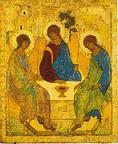
  • Frederica Mathewes-Green, “The Old Testament Trinity,” in God the Holy Trinity: Reflections on Christian Faith and Practice, ed. Timothy George (Grand Rapids: Baker, 2006), 83-90. [The title might sound dull, but this is a very beautiful little essay, written by the popular Orthodox writer. The essay is a brief meditation on Rublev's great icon of the Trinity.]

  • Cornelius Plantinga, “Deep Wisdom,” in God the Holy Trinity: Reflections on Christian Faith and Practice, ed. Timothy George (Grand Rapids: Baker, 2006), 149-55. [Another chapter from the previous book: a rich and moving homily on the Trinity.]

  • Benedict XVI, “Introduction: An Initial Reflection on the Mystery of Jesus,” in Jesus of Nazareth (New York: Doubleday, 2007), 1-8. [A brief discussion of the Father–Son relation as the central dimension of Jesus’ human existence. The basis of the doctrine of the Trinity lies here, in the humanity of Jesus.]

  • Rowan Williams, “A Man for All Seasons,” Chapter 3 in Tokens of Trust: An Introduction to Christian Belief (Louisville: Westminster John Knox Press, 2007), 57-78. [Like the previous reading, this isn’t strictly focused on the Trinity, but it’s a superb, illuminating, jargon-free account of the relation between Jesus and God – which is the most important thing to grasp when thinking about the Trinity.]

  • Hans Urs von Balthasar, “The Triune Life,” a chapter in Prayer (San Francisco: Ignatius Press, 1986), 177-97. [A moving reflection on the mystery of the Trinity as the heart of ecclesial life.]

  • Vladimir Lossky, Orthodox Theology: An Introduction (Crestwood: St Vladimir’s Seminary Press, 1978), 36-50. [An important and accessible passage from one of the greatest modern Orthodox thinkers, focusing on the relation between the Trinity and human personhood.]

  • Kim Fabricius, “Ten Propositions on the Trinity”. I might seem a bit biased here, but you really can’t go past Kim’s post on the Trinity – it’s concise, profound, beautiful, and best of all true.]

Labels:

hat tip to "Faith and Theology" ... read it HERE.