24 October 2006

Images/Metaphors of Communion III - The Breakfast Club


From the Sacred to the Profane (or the profane to the sacred)...perhaps the Breakfast Club is a good model of communion..."Five Strangers with nothing in common except each other" (if we added "in Christ" to the end of the tagline, we might have a church community!)

I betray my age and taste in movies, but I think this image might really work ... I wonder if my thesis advisor will aprove of this working metaphor?

Images of Communion II - The Trinity


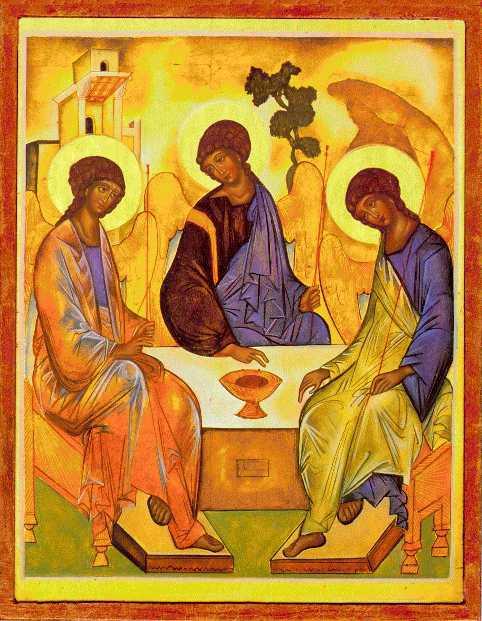
The Trinity has been offered as a model of communion by many theologians. Recently, then Cardinal Ratzinger (now Pope Benedict XVI), the metropolitan (Orthodox titular bishop) John D. Zizioulas, and protestant theologian Miroslav Volf have all offered the Trinity as a model or image of communion.

The image above is from a reproduction of Rublev's Icon of the Trinity. I will return to this question of how the Trinity can be seen as the model of communion, and how this is a strong and helpful root metaphor, but also a metaphor that can be difficult and tricky (to say the least) to approach ...

What is your understanding of the Trinity? How much do you think "unity in difference" and the movement of the Trinity (perichoresis) informs and affects the Church in its understanding of itself? More to come on these questions later ...

Fellowship of the Ring and Communion, continued

an interesting similarity? ...

Gandalf the White


Archbishop of Canterbury, Rowan Williams

21 October 2006

Metaphors of Communion I - Lord of the Rings

What are the working metaphors of communion, of community, that we rely upon...before turning to the Trinity and the Body of Christ, I'd love to explore other metaphors or images of communion...

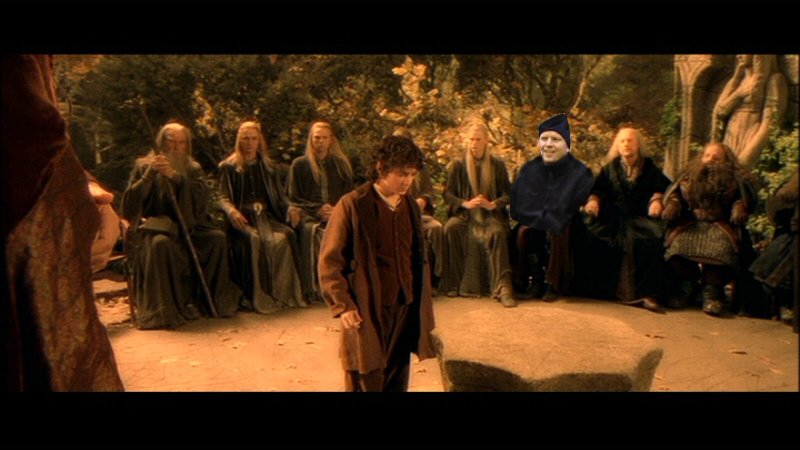
For those Tolkien fans out there, I find the Fellowship of the Ring an interesting model of communion that relies upon a vast diversity...

(you may see a familiar face among the dwarves and elves..., my apologies to Steven Jackson, and J.R.R.!)
The fellowship is brought together to discern a purpose (a calling/vocation?), and there is a wide diversity among the group. As they gathered at Rivendell tension and seriousness dominated; What would they do with the Ring of Power? From the elves to the dwarves to the humans to Gandalf and the hobbits there was a whole history of conflict and collaboration that could not be denied. This was no campfire meeting, and the gathering did not deny the particularity of any of the members. The dwarf, Gimli, even tried to destroy the ring with his broadaxe - without success. They sat in a circle and it wasn't until a Hobbit (a child?) entered the circle and said that he would take the ring and destroy it that they were moved into action.

As the journey continued, there were times of common mission, there were times of conflict, members of the fellowship perished, and there was a breaking of the fellowship - though, in the end it was restored, as something new and different.

Not an exact analogy or metaphor, but an interesting one to consider when examining the Church and its unity and diversity and common purpose but also its vast disagreements.

Other images & metaphors of communion soon, stay tuned...

20 October 2006

Seeing Properly ... Rowan Williams on the Church

In his 2004 essay on "The Christian Priest Today," Archbishop of Canterbury Rowan Williams offers a vision of the church where we can "see properly"...which meshes interestingly with Bonhoeffer's claim that the church is where we can listen and hear properly. You can read his excellent essay here. He claims that many people have:

"a view of the Church that is very seductive and very damaging – and very popular. This is the view that the Church is essentially a lot of people who have something in common called Christian faith and get together to share it with each other and communicate it to other people ‘outside’. It looks a harmless enough view at first, but it is a good way from what the New Testament encourages us to think about the Church – which is that the Church is first of all a kind of space cleared by God through Jesus in which people may become what God made them to be (God’s sons and daughters), and that what we have to do about the Church is not first to organise it as a society but to inhabit it as a climate or a landscape. It is a place where we can see properly – God, God’s creation, ourselves. It is a place or dimension in the universe that is in some way growing towards being the universe itself in restored relation to God. It is a place we are invited to enter, the place occupied by Christ, who is himself the climate and atmosphere of a renewed universe.” Rowan Williams in The Christian Priest Today

So, in this statement we hear that the Church is the “place where we can see properly – God, God’s creation, ourselves. It is a place or dimension in the universe that in some way growing towards being the universe itself in restored relation to God.” Yes, Yes, Yes, I say. This is what the church is called to be, and what the church is, and this is quite an adventure, yes, this “life of a Christian is, indeed, a vast adventure!” However, this statement is a challenge to church structure, practice, and a "personality" that does not lift up the church as the place where we can really “see properly.”

But, I feel we need a reality check here...is the church a place where we can SEE, or LISTEN properly, or is it more about holding onto the status quo, and clinging tightly to old wine in old wineskins? Is this dynamic and changing church the one that we see, or is this picture far far too idealistic?

On a related note... one of my professors at VTS, Dr. Stephen Cook, has an excellent reflection on Amos in which he discovers an interesting dichotomy between "seeking" and "clinging" and you can see it here.