Though it may appear that I am mostly just a blogger, I actually have begun to explore how Bonhoeffer, Rowan Williams, and James Cone may do some 'work' for me as I try to construct an Ecclesiology of Communion. So, here's a bit of a summary of what I've been working on...
The conversation about communion has begun with Dietrich Bonhoeffer and his deep sense that the church is constituted socially by Christ, as he states in No Rusty Swords, “The church is the hidden Christ in our midst.” In this ecclesiology, Christ is at the center, and full communion is known within and between people as they encounter Christ and one another. Bonhoeffer observes communion as the key to people’s encounter with God. Christ is at the center, bringing people to one another, and to God.
Bonhoeffer’s concept of church is in some contrast to Rowan Williams’ thought that the church is made up of the forgiven community. For Williams, the church was constituted through the forgiveness of the resurrected Christ who then calls the church to the practice of forgiveness. Under girding this practice of forgiveness, Williams claims, is the importance of the memory of being forgiven. In his view, the church is contingent upon God’s gift and, as such, exists in judgment. The judgment of the church is illustrated particularly well today by those, such as James Cone, who point out the ways that systemic sin such as racism infect every part of its structure and practice.
Of course, there are further questions and tensions to explore, such as: What are the points of contact and points of inconsistency between Bonhoeffer’s confessing church and Williams’ established church? How is memory related to forgiveness? In addition, the question of: what is the role of the sacraments for this notion of communion?
03 December 2006


01 December 2006
The Body of Christ has AIDS!
As a recent article stated about a soon to be ordained Lutheran pastor who has AIDS, "The Body of Christ has AIDS." If we were to take on this level of social understanding of each of us as members of this body, that is afflicted by HIV/AIDS, would this understanding lead us to combat HIV/AIDS with greater effort and diligence?
I don't know, but I sure think we need to do more; I need to do more!

I don't know, but I sure think we need to do more; I need to do more!
Images of Communion: "The Goonies"

Kudos to SW for her suggestion that a great image of communion is the 80s movie, the Goonies. I must say that my memory is foggy about this movie as I was still mourning the cancellation of the A-Team in 1985 (another great model of communion, if you ask me - and "I pity the fool" who doesn't agree ;)

Goonies Trailer
28 November 2006
Bonhoeffer's Christology Lectures
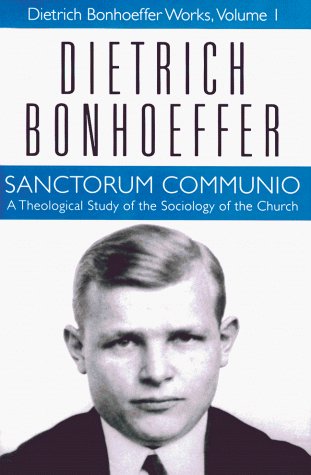
There is so much to reflect upon in Dietrich Bonhoeffer's lectures on the Docrine of Christ given in 1933. This quote reflects much of Bonhoeffer's sense that Christ is present in the congregation, and that the congregation is the Body of Christ. For Bonhoeffer (at least in these lectures), his discussion of church and communion rest upon the work of Christ.
"The Word is the congregation insofar as the congregation is a receiver of the Word. The sacrament is also both in the congregation and there as congregation. Beyond the Word it has in itself already a bodily form. This form of his embodiment is the body of Christ himself and is as such at the same time the form of the congregation. This is no mere image. The congregation is the Body of Christ. It really is what it says it is. The concept of the body applied to the congregation is not a functional concept that relates itself to the members, but instead it is a concept about the way of existence of the present, risen and humiliated Christ."
18 November 2006
Where we might see communion?
After 10 days of being distracted by actually writing my thesis, working on the new humor blog on the GOEs, and other work, I return her to ask: Where might we actually see communion?
There are numerous ways to describe the Church, even in the New Testament there are over 100 metaphors, analogies, and images that are used (according to my Catholic University professor).
One element that I think is absolutely essential for true communion is a healthy and robust sense of humility based in a deep understanding of brokenness, falling short of one's true nature, not living into one's better self, and, dare I say, sin. When people gather together with a deep sense of confession, humility, and vulnerability - here is where they most fully experience God's grace and communion with us, and where they can experience one another in communion.
Where might we actually see communion?
It is a difficult question, for our lives and our relationships, and our families, and our communities and our churches all have conflict and the challenges of difference.
So, dipping my toe in the waters of the visible church of the Anglican Communion and The Episcopal Church, I offer up a few thoughts:
First, this article, posted on the Times Online Blog of Ruth Gledhill, describes Rowan Williams and the fact that when he was at Cambridge he received a hard time from evangelicals who thought he was too liberal, now he's receiving a hard time from folks on the other side of that equation. Ms. Gledhill has some insightful thoughts on this observation which may be a model for us as well.
Second, after hearing a wonderful lecture and discussion by the Anglican Feminist Theologian Sarah Coakley yesterday, I realize how much more I need to reflect upon the Trinity, and whether the Trinity can really be a model for us in this visible, real world. She offered to me a greater vision of the mystical aspect of the Trinity, and caused me to wonder just how far the Trinity can be helpful for the building of an ecclesiology of communion.
There are numerous ways to describe the Church, even in the New Testament there are over 100 metaphors, analogies, and images that are used (according to my Catholic University professor).
One element that I think is absolutely essential for true communion is a healthy and robust sense of humility based in a deep understanding of brokenness, falling short of one's true nature, not living into one's better self, and, dare I say, sin. When people gather together with a deep sense of confession, humility, and vulnerability - here is where they most fully experience God's grace and communion with us, and where they can experience one another in communion.
Where might we actually see communion?
It is a difficult question, for our lives and our relationships, and our families, and our communities and our churches all have conflict and the challenges of difference.
So, dipping my toe in the waters of the visible church of the Anglican Communion and The Episcopal Church, I offer up a few thoughts:

First, this article, posted on the Times Online Blog of Ruth Gledhill, describes Rowan Williams and the fact that when he was at Cambridge he received a hard time from evangelicals who thought he was too liberal, now he's receiving a hard time from folks on the other side of that equation. Ms. Gledhill has some insightful thoughts on this observation which may be a model for us as well.

Second, after hearing a wonderful lecture and discussion by the Anglican Feminist Theologian Sarah Coakley yesterday, I realize how much more I need to reflect upon the Trinity, and whether the Trinity can really be a model for us in this visible, real world. She offered to me a greater vision of the mystical aspect of the Trinity, and caused me to wonder just how far the Trinity can be helpful for the building of an ecclesiology of communion.
08 November 2006
Communion as Communion?
Ah, the most obvious model may have escaped my initial notice...
What I LOVE about Leonardo Da Vinci's Last Supper is that (because of an experimental fresco technique) the painting looks pretty cloudy, ephemeral and perhaps hard to really see, or experience....much like Communion? When we think we "have it" it seems to be fleeting. The Holy Eucharist can transform us, but I just hope we might continue to join with each other at the table.
What I LOVE about Leonardo Da Vinci's Last Supper is that (because of an experimental fresco technique) the painting looks pretty cloudy, ephemeral and perhaps hard to really see, or experience....much like Communion? When we think we "have it" it seems to be fleeting. The Holy Eucharist can transform us, but I just hope we might continue to join with each other at the table.
 |
| From Images of Com... |
05 November 2006
In Christ and with one another
I gained some hope in the following quote from our new Presiding Bishop.
"If some in this church feel wounded by recent decisions, then our salvation, our health as a body, is at some hazard, and it becomes the duty of all of us to seek healing and wholeness."
-Presiding Bishop Katharine Jefferts Schori
-Presiding Bishop Katharine Jefferts Schori
We are constituted in Christ and we are a Body of Christ, not mere islands unto ourselves. I do hope that we can walk humbly and compassionately with one another, and that we all can see that we need one another.
01 November 2006
How does Trinity deal with Conflict?
Well, with our brief fall holiday, I've been blogging quite a bit...perhaps too much to really keep up with...
A question (and answer!) that Steve raised earlier (click here to read it) is an excellent one, and one really near the heart of my thesis (and some of our struggles in the Anglican Communion - and in the larger Church - today).
"The Trinity is, in all actuality, the supreme example of relationship (between the Godhead and humaity surely, but even more so between individual human beings, groups of human beings, and human beings and the rest of Creation).
Where this example gets stuck however is conflict. How does the Trinity deal with conflict within itself? Does the Trinity deal with conflict within itself? If it does, it surely does not respsond with violence, or polarization, but rather with love, with the continuation of the dance, and with mutual respect."
A question (and answer!) that Steve raised earlier (click here to read it) is an excellent one, and one really near the heart of my thesis (and some of our struggles in the Anglican Communion - and in the larger Church - today).
"The Trinity is, in all actuality, the supreme example of relationship (between the Godhead and humaity surely, but even more so between individual human beings, groups of human beings, and human beings and the rest of Creation).
Where this example gets stuck however is conflict. How does the Trinity deal with conflict within itself? Does the Trinity deal with conflict within itself? If it does, it surely does not respsond with violence, or polarization, but rather with love, with the continuation of the dance, and with mutual respect."
With all its depth and strength as a model of Church, how can the Trinity
(locked together in perichoresis (or detention ;))
allow for conflict, prophetic voice, or disagreement?
(locked together in perichoresis (or detention ;))
allow for conflict, prophetic voice, or disagreement?
28 October 2006
One Church, One Hope - Rowan Williams' lecture
Archbishop of Canterbury, Rowan Williams, delivered an amazing lecture in August, 2006 on "One Church, One Hope." My friend, Scott P let me know about this lecture earlier this fall, but I finally found time to read it carefully and fully ... I quote Archbishop Rowan twice below ...
"In Eph. 4, we are told that as Christians we have one hope as we have one Lord, one faith and one baptism, one God and Father. To have one hope is the sign of our one calling, so it appears in this passage. And the common life of the Body of Christ which is discussed in this chapter of Ephesians is clearly manifest in the unity of our hope. Do we need to say, then, that the unity of Christians becomes most visible when Christians visibly share one hope? And what does sharing one hope mean?
The rest of this section of Ephesians gives us a powerful clue. We are called together so that we may grow together towards the fullness of humanity that is Jesus Christ. To have one hope is to move away from the ‘childish’ state in which we are blown around by the motivations, thoughts or ideas of the moment or by the manipulation of others. Maturity is possessing some kind of steady identity – having settled conviction and purposes, and having some awareness of what it is that each has to give into the common life of the community of believers. What we hope for is a humanity in which human gifts flow together, in which the strength of each is resourced from the strength of others, and the strength of each is offered for the strength of others. The one hope is inseparable from the nourishing of diverse strengths. It is about helping each other to become as fully adult in belief and activity as each can be.
In this light, we could say that our one hope was connected with our responsibility to and for each other. In the new creation, in the universe redefined by Christ, no-one reaches or enjoys maturity in isolation; to grow up is not to reach independence in the abstract but to arrive at that kind of understanding of yourself and others that enables you to direct your resource – inner and outer – to the other, taking responsibility for their nurture as they do for yours."
"Everything thus depends upon the sequence spelled out in our text from Ephesians. We are one Body – one diversified, interdependent form of life – animated by one Spirit – one divine agency bestowed upon us to free us to pray. We thus recognise one hope, depending on the single calling we have together received from the one Lord; we respond with one act of trust and self-commitment to the divine Source of all, which we are now enabled to address with the intimacy of a child. And in that childlike intimacy, we learn the maturity we need, Christ’s own fullness and liberty; we become free from manipulation and shallow instability. All serious thinking about the Church’s structures and the Church’s engagement in the world begins here and must return here for testing and discernment. Our own identity as Catholic communities must be defended on this ground, not on any reactive anti-papalism, nor as a pragmatic middle way. In all humility, we need to be able to say that our structures and culture are our gift to the universal Church, our way of living out our one hope in the midst of human diversity; and we invite our brothers and sisters of other confession and traditions to be open to this, as we seek to be open to what God has given them."
27 October 2006
Images of Communion - "Church" and "Christ"

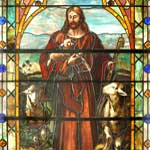 I offer these two images, one of St. Stephen's Episcopal Church, Middlebury, Vermont, my home church and the other image of Jesus as the Good Shepherd that was the image in the chapel in that church where I first had Sunday School. Other than a gratuitous march down memory lane, these images for me (personally) are both helpful and limiting in my view of what church is, what "communion" is. My working "model" of Christ and of Church go to these two images.
At this church is where a decent variety and diversity of God's people gathered, it is where we did participate in communion with one another and with God. It is where I learned a great deal of the faith, and a great deal about myself. It is where I came to love the liturgy, music, and practices of the faith, and where I first really encountered the living God. St. Stephens is also where I felt the tension that the church was sometimes slow to respond to needs in the community, and where I thought deeper communion could be had - it is where I was able to question my faith, and yet keep coming to the altar rail to participate.
I don't offer these images necessarily as universally helpful models of Church or of Christ or of Communion, but I believe that we all carry with us some images that are our own "working images," and unless we name (and perhaps critique) them, we cannot transform and allow the Spirit to breathe new life into them ...
I wonder whether we, in the Church, need to name the working images and metaphors that both help and constrain us as we walk and work and worship together?
Elements of Communion - Participation & Richard Hooker

Richard Hooker, (1554-1600), one of the giants of Anglican thought wrote much in his Of the Lawes of Ecclesiastical Polity (1593) (read them here!) about "participation." In the Eucharist the gathered community "participates" with God. God has made this a place where the gathered community might "participate" in the divine mystery ... Through this participation, the community is constituted one to another within and because of God, and through this participattion the community is strengthened and transformed by the power and mystery of God.
So, what if we cannot seem to bring ourselves to gather at the table or altar or altar rail? What if we excommunicate ourselves when we choose not to gather together as the people of God, believers in Christ, and through the power of the Spirit? To echo what Steve mentioned in a comment earlier (here), how does this sacramental vision deal with conflict? How do we understand communion when some choose not to gather at the altar? What if some, as a matter of conscience, just cannot bring themselves to gather at the altar?
Can there be a model of communion that both affirms the importance of gathering with a truly diverse people, while also affirms the prophets in the midst who might challenge that unity?
This (in my humble opinion) is the place and the context in which things get very tricky, and also where people feel pain and heartache, loss and betrayal ... communion is one of those ephemeral types of entities that may, indeed, be quite impossible for humankind. "But with God all things are possible." Though it may be difficult to impossible here in this human life, we still strive for it, and we strive to construct a model that might lead us to a fuller understanding and experience of God.
24 October 2006
Images/Metaphors of Communion III - The Breakfast Club

I betray my age and taste in movies, but I think this image might really work ... I wonder if my thesis advisor will aprove of this working metaphor?
Images of Communion II - The Trinity
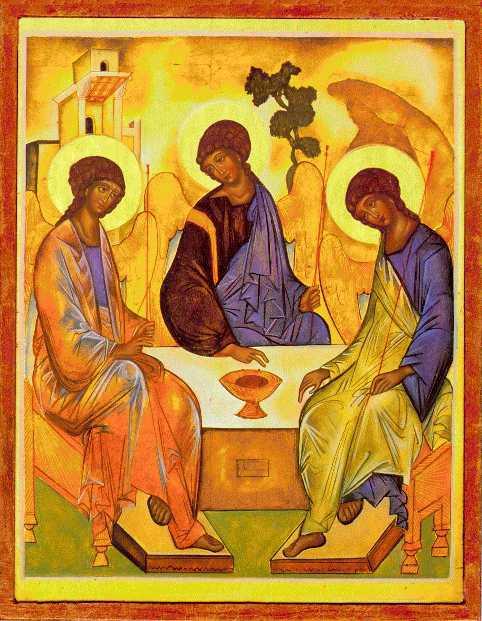
The image above is from a reproduction of Rublev's Icon of the Trinity. I will return to this question of how the Trinity can be seen as the model of communion, and how this is a strong and helpful root metaphor, but also a metaphor that can be difficult and tricky (to say the least) to approach ...
What is your understanding of the Trinity? How much do you think "unity in difference" and the movement of the Trinity (perichoresis) informs and affects the Church in its understanding of itself? More to come on these questions later ...
Fellowship of the Ring and Communion, continued
an interesting similarity? ...
 Gandalf the White
 Gandalf the White
Archbishop of Canterbury, Rowan Williams
21 October 2006
Metaphors of Communion I - Lord of the Rings
What are the working metaphors of communion, of community, that we rely upon...before turning to the Trinity and the Body of Christ, I'd love to explore other metaphors or images of communion...
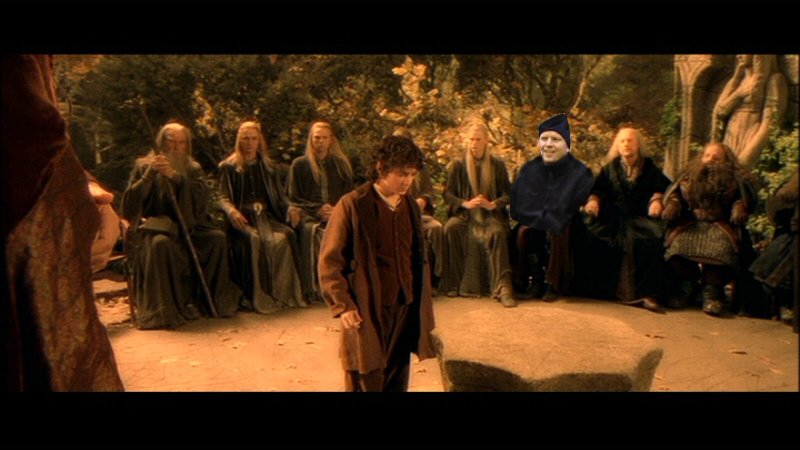
For those Tolkien fans out there, I find the Fellowship of the Ring an interesting model of communion that relies upon a vast diversity...
 (you may see a familiar face among the dwarves and elves..., my apologies to Steven Jackson, and J.R.R.!)
The fellowship is brought together to discern a purpose (a calling/vocation?), and there is a wide diversity among the group. As they gathered at Rivendell tension and seriousness dominated; What would they do with the Ring of Power? From the elves to the dwarves to the humans to Gandalf and the hobbits there was a whole history of conflict and collaboration that could not be denied. This was no campfire meeting, and the gathering did not deny the particularity of any of the members. The dwarf, Gimli, even tried to destroy the ring with his broadaxe - without success. They sat in a circle and it wasn't until a Hobbit (a child?) entered the circle and said that he would take the ring and destroy it that they were moved into action.
As the journey continued, there were times of common mission, there were times of conflict, members of the fellowship perished, and there was a breaking of the fellowship - though, in the end it was restored, as something new and different.
Not an exact analogy or metaphor, but an interesting one to consider when examining the Church and its unity and diversity and common purpose but also its vast disagreements.
For those Tolkien fans out there, I find the Fellowship of the Ring an interesting model of communion that relies upon a vast diversity...
 (you may see a familiar face among the dwarves and elves..., my apologies to Steven Jackson, and J.R.R.!)
The fellowship is brought together to discern a purpose (a calling/vocation?), and there is a wide diversity among the group. As they gathered at Rivendell tension and seriousness dominated; What would they do with the Ring of Power? From the elves to the dwarves to the humans to Gandalf and the hobbits there was a whole history of conflict and collaboration that could not be denied. This was no campfire meeting, and the gathering did not deny the particularity of any of the members. The dwarf, Gimli, even tried to destroy the ring with his broadaxe - without success. They sat in a circle and it wasn't until a Hobbit (a child?) entered the circle and said that he would take the ring and destroy it that they were moved into action.
As the journey continued, there were times of common mission, there were times of conflict, members of the fellowship perished, and there was a breaking of the fellowship - though, in the end it was restored, as something new and different.
Not an exact analogy or metaphor, but an interesting one to consider when examining the Church and its unity and diversity and common purpose but also its vast disagreements.
Other images & metaphors of communion soon, stay tuned...
20 October 2006
Seeing Properly ... Rowan Williams on the Church
 In his 2004 essay on "The Christian Priest Today," Archbishop of Canterbury Rowan Williams offers a vision of the church where we can "see properly"...which meshes interestingly with Bonhoeffer's claim that the church is where we can listen and hear properly. You can read his excellent essay here. He claims that many people have:
 "a view of the Church that is very seductive and very damaging – and very popular. This is the view that the Church is essentially a lot of people who have something in common called Christian faith and get together to share it with each other and communicate it to other people ‘outside’. It looks a harmless enough view at first, but it is a good way from what the New Testament encourages us to think about the Church – which is that the Church is first of all a kind of space cleared by God through Jesus in which people may become what God made them to be (God’s sons and daughters), and that what we have to do about the Church is not first to organise it as a society but to inhabit it as a climate or a landscape. It is a place where we can see properly – God, God’s creation, ourselves. It is a place or dimension in the universe that is in some way growing towards being the universe itself in restored relation to God. It is a place we are invited to enter, the place occupied by Christ, who is himself the climate and atmosphere of a renewed universe.” Rowan Williams in The Christian Priest Today
So, in this statement we hear that the Church is the “place where we can see properly – God, God’s creation, ourselves. It is a place or dimension in the universe that in some way growing towards being the universe itself in restored relation to God.” Yes, Yes, Yes, I say. This is what the church is called to be, and what the church is, and this is quite an adventure, yes, this “life of a Christian is, indeed, a vast adventure!” However, this statement is a challenge to church structure, practice, and a "personality" that does not lift up the church as the place where we can really “see properly.”
But, I feel we need a reality check here...is the church a place where we can SEE, or LISTEN properly, or is it more about holding onto the status quo, and clinging tightly to old wine in old wineskins? Is this dynamic and changing church the one that we see, or is this picture far far too idealistic?On a related note... one of my professors at VTS, Dr. Stephen Cook, has an excellent reflection on Amos in which he discovers an interesting dichotomy between "seeking" and "clinging" and you can see it here.
Sanctorum Communio, reflections on Bonhoeffer
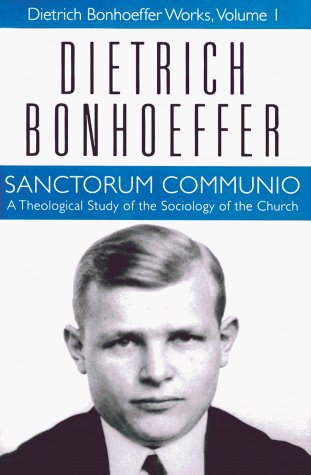
Dietrich Bonhoeffer wrote his first (of two!) dissertations (at age 21!!!) for his Ph.D on "Santorum Communio," the Sacred Community, the sanctified community. For him, the community, and the communion of Christians was essential for the Christian life. In the collection of his Letters and Papers from Prison, he offers many reflections on community...
From a letter to his parents –
“I have also been considering again the strange story of the gift of tongues. That the confusion of tongues at the Tower of Babel, as a result of which people can no longer understand each other, because everyone speaks a different language, should at last be brought to an end and overcome by the language of God, which everyone understands and through which alone people can understand each other again, and that the church should be the place where that happens – these are great momentous thoughts.” (Letters and Papers from Prison, 53)
The first reflection describes communion as the place where we can finally hear and listen to one another ... this truly happens only through the action of God. There is something deeply helpful and also challenging here. True communion may not really be possible without the gift of God's grace ... we work for it, and we approach it, but can we ever really know it?
to his parents –
“It is a strange feeling to be so completely dependent on other people; but at least it teaches one to be grateful, and I hope I shall never forget that. In ordinary life we hardly realize that we receive a great deal more than we give, and that it is only with gratitude that life becomes rich. Its very easy to overestimate the importance of our own achievements in comparison with what we owe to others.” (Letters and Papers from Prison, 109)
We don't really like to feel dependent, and Bonhoeffer knew dependence more than most ... living in prison. Dependency reminds us that all we have is gift, and that we must bind ourselves to one another in order to survive. I wonder how we help remind people of their communal lives and the ways in which we all are dependent upon one another.
Here
http://santospopsicles.blogspot.com
15 October 2006
Initial Question....

What is communion?
Ok, to get the ball rolling, I am interested in your reflections on the idea of "communion." What is communion? Of course, for those of us in the Anglican Communion (at least for now...), "Communion" is something confusing enough, but I am also very interested in what "communion" would be, for you? What would it "look like" to have communion? What is needed for it? Can humankind even really know it? (or is it so much dependent upon God that we would only see it dimly...)
[the image is of the "Eagle & Child," the pub in Oxford, England where CS Lewis, JRR Tolkien
and others met to discuss their work , we should be so lucky to have their communion!]
and others met to discuss their work , we should be so lucky to have their communion!]
Just for some reflection:
Biblical Roots of Communion
Tradition of Communion
Liturgical aspects of Communion
Sacramental aspects of Communion
Images of Communion
As my thesis title is "An Ecclesiology of Communion," I have some ideas on this (as I have drawn from Bonhoeffer, Rowan Williams, James Cone and others, but I wonder what you think?)
Please comment as you are willing and able ...
28 August 2006
Welcome !
Welcome to this blog to discuss questions of Communion, Difference, Hospitality, and Reconciliation as they relate to a Theology of the Church (Ecclesiology). I am exploring some of these questions in a thesis at Virginia Theological Seminary, an Episcopal Seminary in Alexandria, Virginia. Periodically, I will post ideas, questions, thoughts and I welcome any and all comments in response to them. What follows below is a bit from my thesis proposal:
My working hypothesis is that the Church is called to welcome with hospitality and reverence all those who might be termed other, in order to respond to God’s high calling of the Church. When the Church loses its essential theological grounding the Church exists in a risky position, and can become merely another social or political entity. When churches solely reminisce about the world and will not live into the reign of God, we run the risk of losing ecclesial identity. In serving God, and existing under judgment from God, the Church is called to see the world as God might see it—in fullness, diversity and unity. When churches are made as exclusive places (wherever they might exist on whatever spectrum), we are making some claims, perhaps implicitly, about God (and limiting God). In encompassing difference within our ecclesiology, we move closer to God’s vision for the church.
Just as the Church exists both with the Grace of God, and also exists in Judgment, my hypothesis is a working one, and a starting point and ‘exists under judgment’. Starting with Dietrich Bonhoeffer’s understanding of ecclesiology, and then moving into Rowan Williams work, I will be challenged and my conclusions about an ecclesiology difference will become more clear and nuanced. Finally, engaging in conversation with James Cone and his quite different understanding of a theology of difference and liberation, I expect his work to help me to examine potential holes and problems with my work. Other challenges to my assumptions and those of my principal "conversation partners" will be explored as I progress through this thesis journey.
Thanks for visiting! Be sure to offer your comments!
13 August 2006
Sermon, 13 August 2006, Proper 14 B
Peter Carey, Guest Preacher, Church of the Redeemer, Bryn Mawr
13 August 2006, Proper 14 B
Psalm 14; Deuteronomy 8:1-10; Ephesians 4:30-5:2; John 6:37-51
What are the tricks that you use to remember things? When I was a kid, my grandmother used to say that tying a string around your finger would help. The problem with that is that all I would remember is that I forgot something. In the Harry Potter books there is a magical device called a “remembrall” which glows when its owner has forgotten something. However, once again, it does not tell you what you have forgotten.
There ARE a lot of things to remember – ATM passwords, birthdays, directions, addresses, to do lists, car inspection date, bills, meeting with the bishop, preaching at Redeemer, the books of the Bible, Spanish vocabulary, the baby’s favorite toy, remembering to pray, my wedding anniversary, and where did I put the keys?
And so, I have a Palm Pilot with years of appointments and hundreds of addresses. I have a cell phone with dozens of numbers. I keep a journal to remember my thoughts and ideas and I’m working on putting my keys next to the door when I enter our apartment. It can be hard to remember. My friends tell me it only gets worse as I get older.
What about remembering God? One theologian had the interesting definition of sin as “God-forgetfulness,” which appeals to me. How do we live when we forget God?
Remembering God is a key theme in today’s reading from Deuteronomy, whose author offers an interpretation of the story of Israel’s time in the wilderness. A bit of research tells us that this text was written once the Israelites were well-established in the Promised Land, perhaps even several generations after the time in the wilderness.
The People Israel were called to remember the time in the Wilderness, so they would remember God, and would continue to live according to his covenant – Covenant to God, and Covenant to One another.
The People are urged to remember the time in the wilderness. In the wilderness they had an experience of the divine, and they learned that all they have is gift from God, and they learned total dependence upon God.
Total dependence upon God. The wilderness forced them to see that they are not God. In the wilderness, it is clear that they are not in control of their lives, instead, all they have is a result of the Grace of God and the goodness of God. In the wilderness, they were dependent upon God, and upon each other for their survival. …
The People were fed in the Wilderness. They were fed manna, which was enough to sustain them, but it did not last beyond the day. I sometimes wonder what this manna was. Was it bread, was it some kind of a PowerBar substance that wasn’t so tasty to eat? What was it? Well, no one really knows exactly what this substance was but we know that the Israelites weren’t ecstatic about it after eating Egyptian delicacies. What we do know is that the manna was enough but not more than that. Every day the manna had to be collected and the people had to serve one another. Likely, the healthy and strong needed to gather the manna for the sick and weak. The distribution of it had to be done by the whole people, not just the priests! There was no scarcity, but there was no extra. The wilderness forced the Israelites to see that they were dependent upon one God, but also that they were dependent upon each other. The manna falls from heaven, and must be consumed that day. There is no time to hoard the food, and to get everyone fed, communal practices develop. These communal practices of hospitality and care developed and became a part of the culture. However, as is wont to happen, once the time of the wilderness was over, they began to forget the myriad ways that God Provides.
From the wilderness we learn to remember God, and also to practice a faith that is in concert with others. From the wilderness, the whole body of God’s faithful people works together and is sustained by mutual care and affection. They were sojourners in the land, they were the outcast, outside of the comfortable lands of Egypt, and not yet resting in the land of promise. The wilderness was where God taught them. There they learned humility. There they learned the pains of hunger. There they learned to depend on God. There they experienced the hospitality that God provides.
We sometimes want to try to forget the tough times, to get over them, to put them behind us. This passage in Deuteronomy does not let the People Israel forget – on the contrary – the writer challenges them to remember the wilderness times. The writer challenges them to remember their tradition, to remember the history of how they got where they are, to see the shoulders on which they stand, to see the journey that their ancestors made.
Many times in the Bible, the story of the Exodus is retold, as in today’s reading from Deuteronomy. Clearly, this story was retold many times and it is important enough to be remembered! God provided for the People Israel, and they were to remember, and to be thankful.
We have been given great gifts. However, the main condition to receiving these gifts is that we remember, we remember that we are dependent upon God, we remember that our very lives are contingent upon God’s grace, and we remember that we are not God!
When we get comfortable and have spent time away from the wilderness, we might begin to forget our centrally dependent nature. We might forget our call to obedience. We might forget to call out the name of our Lord in prayer and praise. In the wilderness, God is a central part of the lives of the People, and in our own times of sorrow, pain, and darkness we also turn to God. However, God is not just the God of the wilderness, God is not just the God of the borders, or of the gaps in our lives where we can’t explain using our thinking and our science. God is always there, supporting us and providing for us!
When we remember what God has done for God’s people, and what God has done for each of us, we experience that our very being flows from God. When we remember God we see that all we have is temporary, we see that our present struggles will pass away, and we will be dust. When we live remembering the wilderness we begin to really pray. The Catholic monk Thomas Merton likened deep prayer to the experience of hanging over an abyss by the hairs of your head. Total dependence; focused prayer.
We are not the lords of our lives. Initially this may strike fear into our hearts. However, when we realize that we are ever resting upon God, that we are ever living in the loving hands of God we live with the certainty that we are surrounded by a loving embrace. God is in the center of the wilderness AND God is at the center of our lives. We are reminded by the writer of Deuteronomy to remember God’s work in the wilderness so that we might see that God is also incarnate and real, here in the midst of our lives.
While it is good to remember the wilderness, let me be clear God does not need us to remember God. God is with us. God’s grace is with us at all times.
Jesus reminds his followers of the way that God provided for the People Israel, but goes further. He makes the point that now God is providing the bread of eternal life. In the gift of Jesus to the world, Jesus is the Bread of Life. While the manna disappeared at the end of the day, the bread of life is never diminished. We remember the wilderness and when God was in the center of the Isralites’ lives. In Christ, God is incarnate, real, and central in the very midst of our lives. Christ is the Bread of life, and as bread, Christ is in the mundane and the real, the overlooked and the everyday. For this we are extremely thankful. We do not need to go to the wilderness to experience the goodness of God. We can eat the living bread in the midst of our lives and be one with the Body of Christ.
We remember and we give thanks as we participate in the Eucharist. Eucharisto – thanksgiving – thanksgiving and also we remember all that God has done for us. In this thanksgiving, we feed one another and are unified in Christ. We gather, we remember as we break bread that we are one in Christ. We gather around this Eucharistic table, and we also celebrate God’s incarnate nature as we break bread throughout the other 6 days as well.
As we break toast to feed an infant in a highchair, Christ is there. As we share a plastic-wrapped sandwich from the hospital cafeteria on a tray with wheels, Christ is there. As we share food with the hungry and we break bread with them, Christ is there. In Christ, we have been fed the bread of life, and we experience God in our midst as we give thanks for all the awesome things that God has done for us. We are dependent upon God, and all that we have and all that we are is gift. God’s gift to us is seen here in the creation of the world, the creation of all the wonder around us, and creation of each of us.
As we remember the wilderness of our lives we remember God. God provided for us there the manna from heaven, God taught us to rely upon God. We need not go to the wilderness to meet God. God being God and we being dependent on God does not mean, however, that we have no responsibility. God calls us to practice Godliness to those in wilderness places, in wilderness times. We are called to provide hospitality to those who in the midst of their own wilderness. We practice this hospitality not because we are merely being ‘nice,’ and not to make us feel good about ourselves. Rather, we do this because in these actions we become unified with God and humanity when we provide the bread of life for all those in need (which includes me and you!). Resting in the loving arms of God, we practice Godliness where we “seek and serve Christ in all persons, loving our neighbor as ourselves.”
God was teaching that God is God and we are not! It is upon God that we all depend. And this was a teaching that was forever; not just for the time in the wilderness, but also for God’s people after reaching the Promised Land.
In a few minutes we will gather together, we will bless, break, and give bread that not only helps us to remember God, but also celebrates God in our very midst. And, as we partake in this glorious thanksgiving feast, we feast together in unity upon the Bread of Life and become One as the Body of Christ. After we feed each other, we send each other out to remember and to live in remembrance of all that God did for the Israelites in the wilderness and for all that God does for us through his Son.
There is no need to write it in our PalmPilots for God has written it on our hearts, and has fed us with the Bread of Life so that we might live, and live abundantly.
Subscribe to:
Posts (Atom)