28 October 2006

One Church, One Hope - Rowan Williams' lecture


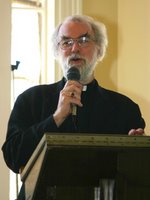
Archbishop of Canterbury, Rowan Williams, delivered an amazing lecture in August, 2006 on "One Church, One Hope." My friend, Scott P let me know about this lecture earlier this fall, but I finally found time to read it carefully and fully ... I quote Archbishop Rowan twice below ...

"In Eph. 4, we are told that as Christians we have one hope as we have one Lord, one faith and one baptism, one God and Father. To have one hope is the sign of our one calling, so it appears in this passage. And the common life of the Body of Christ which is discussed in this chapter of Ephesians is clearly manifest in the unity of our hope. Do we need to say, then, that the unity of Christians becomes most visible when Christians visibly share one hope? And what does sharing one hope mean?

The rest of this section of Ephesians gives us a powerful clue. We are called together so that we may grow together towards the fullness of humanity that is Jesus Christ. To have one hope is to move away from the ‘childish’ state in which we are blown around by the motivations, thoughts or ideas of the moment or by the manipulation of others. Maturity is possessing some kind of steady identity – having settled conviction and purposes, and having some awareness of what it is that each has to give into the common life of the community of believers. What we hope for is a humanity in which human gifts flow together, in which the strength of each is resourced from the strength of others, and the strength of each is offered for the strength of others. The one hope is inseparable from the nourishing of diverse strengths. It is about helping each other to become as fully adult in belief and activity as each can be.

In this light, we could say that our one hope was connected with our responsibility to and for each other. In the new creation, in the universe redefined by Christ, no-one reaches or enjoys maturity in isolation; to grow up is not to reach independence in the abstract but to arrive at that kind of understanding of yourself and others that enables you to direct your resource – inner and outer – to the other, taking responsibility for their nurture as they do for yours."

"Everything thus depends upon the sequence spelled out in our text from Ephesians. We are one Body – one diversified, interdependent form of life – animated by one Spirit – one divine agency bestowed upon us to free us to pray. We thus recognise one hope, depending on the single calling we have together received from the one Lord; we respond with one act of trust and self-commitment to the divine Source of all, which we are now enabled to address with the intimacy of a child. And in that childlike intimacy, we learn the maturity we need, Christ’s own fullness and liberty; we become free from manipulation and shallow instability. All serious thinking about the Church’s structures and the Church’s engagement in the world begins here and must return here for testing and discernment. Our own identity as Catholic communities must be defended on this ground, not on any reactive anti-papalism, nor as a pragmatic middle way. In all humility, we need to be able to say that our structures and culture are our gift to the universal Church, our way of living out our one hope in the midst of human diversity; and we invite our brothers and sisters of other confession and traditions to be open to this, as we seek to be open to what God has given them."

27 October 2006

Images of Communion - "Church" and "Christ"


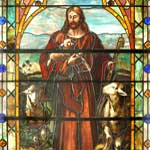
I offer these two images, one of St. Stephen's Episcopal Church, Middlebury, Vermont, my home church and the other image of Jesus as the Good Shepherd that was the image in the chapel in that church where I first had Sunday School. Other than a gratuitous march down memory lane, these images for me (personally) are both helpful and limiting in my view of what church is, what "communion" is. My working "model" of Christ and of Church go to these two images.

At this church is where a decent variety and diversity of God's people gathered, it is where we did participate in communion with one another and with God. It is where I learned a great deal of the faith, and a great deal about myself. It is where I came to love the liturgy, music, and practices of the faith, and where I first really encountered the living God. St. Stephens is also where I felt the tension that the church was sometimes slow to respond to needs in the community, and where I thought deeper communion could be had - it is where I was able to question my faith, and yet keep coming to the altar rail to participate.

I don't offer these images necessarily as universally helpful models of Church or of Christ or of Communion, but I believe that we all carry with us some images that are our own "working images," and unless we name (and perhaps critique) them, we cannot transform and allow the Spirit to breathe new life into them ...

I wonder whether we, in the Church, need to name the working images and metaphors that both help and constrain us as we walk and work and worship together?

Elements of Communion - Participation & Richard Hooker


Richard Hooker, (1554-1600), one of the giants of Anglican thought wrote much in his Of the Lawes of Ecclesiastical Polity (1593) (read them here!) about "participation." In the Eucharist the gathered community "participates" with God. God has made this a place where the gathered community might "participate" in the divine mystery ... Through this participation, the community is constituted one to another within and because of God, and through this participattion the community is strengthened and transformed by the power and mystery of God.

So, what if we cannot seem to bring ourselves to gather at the table or altar or altar rail? What if we excommunicate ourselves when we choose not to gather together as the people of God, believers in Christ, and through the power of the Spirit? To echo what Steve mentioned in a comment earlier (here), how does this sacramental vision deal with conflict? How do we understand communion when some choose not to gather at the altar? What if some, as a matter of conscience, just cannot bring themselves to gather at the altar?

Can there be a model of communion that both affirms the importance of gathering with a truly diverse people, while also affirms the prophets in the midst who might challenge that unity?

This (in my humble opinion) is the place and the context in which things get very tricky, and also where people feel pain and heartache, loss and betrayal ... communion is one of those ephemeral types of entities that may, indeed, be quite impossible for humankind. "But with God all things are possible." Though it may be difficult to impossible here in this human life, we still strive for it, and we strive to construct a model that might lead us to a fuller understanding and experience of God.


24 October 2006

Images/Metaphors of Communion III - The Breakfast Club


From the Sacred to the Profane (or the profane to the sacred)...perhaps the Breakfast Club is a good model of communion..."Five Strangers with nothing in common except each other" (if we added "in Christ" to the end of the tagline, we might have a church community!)

I betray my age and taste in movies, but I think this image might really work ... I wonder if my thesis advisor will aprove of this working metaphor?

Images of Communion II - The Trinity


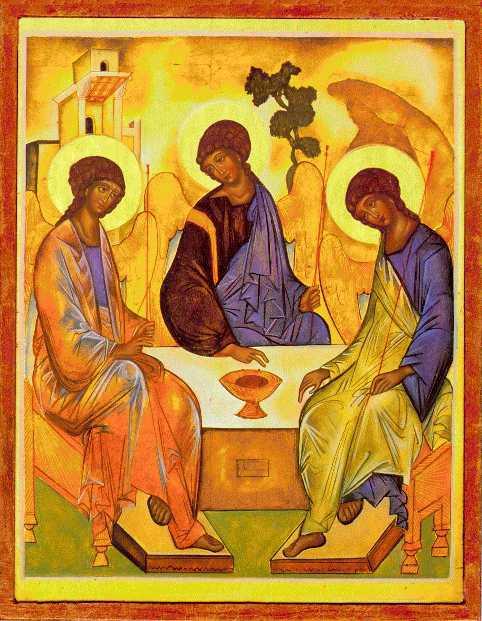
The Trinity has been offered as a model of communion by many theologians. Recently, then Cardinal Ratzinger (now Pope Benedict XVI), the metropolitan (Orthodox titular bishop) John D. Zizioulas, and protestant theologian Miroslav Volf have all offered the Trinity as a model or image of communion.

The image above is from a reproduction of Rublev's Icon of the Trinity. I will return to this question of how the Trinity can be seen as the model of communion, and how this is a strong and helpful root metaphor, but also a metaphor that can be difficult and tricky (to say the least) to approach ...

What is your understanding of the Trinity? How much do you think "unity in difference" and the movement of the Trinity (perichoresis) informs and affects the Church in its understanding of itself? More to come on these questions later ...