Showing posts with label chimayo. Show all posts

16 April 2017

Easter!


O God, your never-failing providence sets in order all things both in heaven and earth: Put away from us, we entreat you, all hurtful things, and give us those things which are profitable for us; through Jesus Christ our Lord, who lives and reigns with you and the Holy Spirit, one God, for ever and ever. Amen.

29 May 2016

Discernment


O God, your never-failing providence sets in order all things both in heaven and earth: Put away from us, we entreat you, all hurtful things, and give us those things which are profitable for us; through Jesus Christ our Lord, who lives and reigns with you and the Holy Spirit, one God, for ever and ever. Amen.

Discernment


O God, your never-failing providence sets in order all things both in heaven and earth: Put away from us, we entreat you, all hurtful things, and give us those things which are profitable for us; through Jesus Christ our Lord, who lives and reigns with you and the Holy Spirit, one God, for ever and ever. Amen.

02 April 2016

About Chimayo, New Mexico, from the "Taos Unlimited" Blog

About Chimayo, from the "Taos Unlimited" Blog:


HIGH ROAD TO TAOS: Here you will find information about this day trip from Santa Fe to Taos, points of interest on the High Road to Taos, and the communities of Nambe, Chimayo, Cundiyo, Cordova, Truchas, Trampas, Chamisal, Penasco, Vadito, Talpa, and Ranchos de Taos. As a bonus, we have included a colorful, topographical map of the area.

Chimayo: An Historic Spanish Settlement
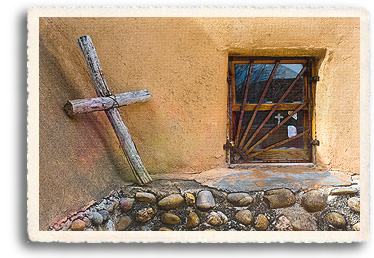
In Chimayó, New Mexico, a handmade cross sits in the corner of a traditional adobe style mission chapel, the Santuario de Chimayo. inside the window is the Sacristy, where pilgrims to the santuario leave rosaries, crutches, gifts and photos as evidence of healing.
The name Chimayo derives from a Tewa name for a local landmark, the hill of Tsi Mayoh. This tiny village, set in the foothills of the Sangre de Cristo Mountains about 25 miles north of Santa Fe, was originally established as a penal colony for the Spanish Empire after their reconquest of New Mexico in 1680. At that time, Spanish colonists settled in the northwestern section of the Chimayo Valley. These hard-working and hardy settlers were farmers and weavers. They raised horses and sheep, and kept fruit orchards. They settled the Chimayo area in hopes of receiving the title of "Hidalgo" (or nobleman) if they prospered. Frequently they were granted land, money and farming implements to help with their struggles in the harsh, dry climate of the high desert.

Chimayo is a town of numerous plazas and placitas. Plazas were rectangles of connected rooms surrounding an open space used as a community vegetable garden. Plazas were originally built for defensive purposes to protect the colonial farmers from raiding Comanches and other tribes.

Plaza del CerroOf note is the fortified Plaza of San Burenaventura, now called the Plaza del Cerro, built in 1749. Today it is the last surviving Spanish fortified plaza in the United States. The Plaza del Cerro is a square built of connecting adobe buildings with two narrow entrances. A watch tower, or torreon, is set on the south side, while a small chapel sits on the western side. There were originally no windows on the outside, and adobe watchtowers probably stood outside each of the walls at one time. The two small entrances, (described as no wider than an ox) on the north and south could be easily and quickly closed to keep out attackers, and the residents could have survived for some time in the plaza interior, although enemies would have had an easy time cutting off their water supply.
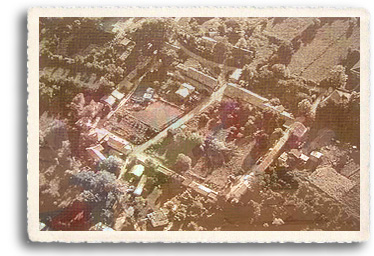
An early photo of the historic fortified Plaza del Cerro in Chimayo, NM
Plaza del Cerro has one of the oldest intact crop irrigation canals, or acequias, possibly built by Indians prior to the coming of the Spanish. Acequias are the life-blood of Northern New Mexico's agricultural areas, funneling snow melt or river water to fields and pastures, where it is allowed to flood agricultural land. Spanish settlers always built their plazas next to these canals, which had diversion channels running into the plaza gardens. Crops inside and outside of the plaza were watered by raising or lowering small gates to channel the water.

The Potrero plaza of Chimayo is known internationally for its tiny chapel and shrine, the Santuario de Nuestro Señor de Esquipulas, commonly known as el Santuario de Chimayo. El Santuario de Chimayo has become known as the "Lourdes of America," for its legendary healing powers based on the miracle of Nuestro Señor de Esquipulas. This small chapel attracts close to 300,000 visitors a year, most of whom take away with them a bit of the "holy dirt" from a small well in the sacristy. The Santuario also attracts thousands of pilgrims who walk dozens, and sometimes hundreds of miles each Easter week to offer prayers of thanks and ask for blessings. El Santuario de Chimayo is the most important Catholic pilgrimage center in the United States, and was designated a National Historic Landmark in 1970.
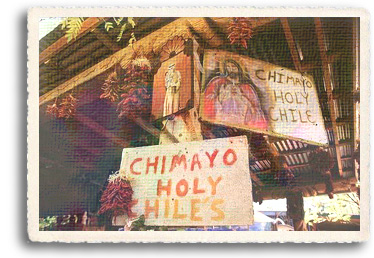
A stand in Chimayó sells Chimayo chile ristras, fruit and retablos. A sign proclaims the chiles are holy.Chimayo is also famous for its heirloom chile (Capsicum annuum "Chimayo"). Of all the crops grown in and around the plazas, none was more important than chile. Chile was not only a food but also a medicine. For cooking, many preferred the milder varieties, and Chimayo is best known for its mild but extremely flavorful peppers. Farmers watched their chile crops closely, not only for harvest, but also because chile was used as a currency for barter, the only crop which was considered valuable enough to be used for this purpose.
Traditional and Contemporary Arts in Chimayo
The tiny town is also well known for the weaving traditions of the Ortega and Trujillo families, who for generations have been producing textiles woven in the Spanish Colonial tradition. By the beginning of the twentieth century, weavings by the Ortega and Trujillo family artists had become so much admired, that the style was named the Chimayo style of weaving. The Ortega and Trujillo families now each operate their own galleries, along with those who still practice other traditional arts such as tin smithing, wood carving, and creating retablos, or paintings of saints on wooden slabs. Other traditional Spanish and Tewa Indian arts still found in Chimayo include bultos (sculptures), colcha embroidery and pottery. Chimayo is also home to numerous very talented contemporary artists as well. Set in the stunning high desert landscape and traditional adobe architecture, the traditional and contemporary artists of Chimayo attract a good deal of tourism to the area.

Pictured top right: Exterior wall of the Santuario de Chimayo

Pictured middle right: Archival photo of the Plaza del Cerro

Pictured bottom right: Roadside stand promises "Holy" Chimayo Chiles

More About the Miracle of el Santuario de Chimayo
Back to The High Road to Taos

18 August 2010

Santos Woodcarving Popsicles...

Visited Chimayo, New Mexico today, and visited the wonderful shop that was the inspiration for this blog. Along the way, took some photos of Chimayo and a brief video.  I will be posting them soon.  We even ate some popsicles from the shop, and bought a few things.  Here's the original description of "Santos Woodcarving Popsicles" from 2007...

The inspiration for this blog came from the photo that was taken at Chimayo, New Mexico in front of a shop. What I really love about this sign is that these three items are not expected to be advertised together, they point to the holy, but also to the everyday, and make no excuses for the everyday and the holy merged and unified.


~The Rev. Peter M. Carey

25 February 2008

Article on Chimayo in the New York Times


The name of this blog, Santos Woodcarving Popsicles, came from a photo that I took in Chimayo, New Mexico in front of a shop that advertised selling these three items. The town is also famous for the shrine there, and for the healing properties of the dirt in the shrine .... an interesting article in the New York Times this week on Chimayo:


An excerpt below, read it all HERE...


February 20, 2008
Chimayo Journal

A Pastor Begs to Differ With Flock on Miracles

CHIMAYO, N.M. — “It’s not the dirt that makes the miracles!” the Rev. Casimiro Roca said with exasperation.

True, discarded crutches line a wall inside the Santuario de Chimayo, a small adobe church in this village of northern New Mexico known as the Lourdes of America.

True, tens of thousands of pilgrims walk eight miles or more to the shrine on Good Friday, some bearing heavy crosses and others approaching on their knees. Scores of people visit every day the rest of the year, many hoping to cure diseases or disabilities with prayer, holy water and, most famously, the healing dirt, which visitors collect from a hole in the floor inside the church.

Now the disparagement of the dirt was jarring, coming from Father Roca, who has devoted much of his life to creating the present-day shrine and is its revered eminence. At 89, he wears a beret that reveals his Barcelona origins.

Some 50 years ago, he took over the abandoned, nearly ruined site of the church, which was first constructed in 1816. He oversaw the rebuilding of the sanctuary — holy hole included — into the spotless place it is today, with bright paintings and statues inside and giant cottonwoods out back that he planted as saplings. It has become a stop for tour buses taking the scenic route to Taos as well as for local residents in search of solace or cures, and was declared a national landmark in 1970. Visitors bring their own baggies or containers or can buy little plastic containers marked “blessed dirt” at the church’s gift shop.


Read the rest HERE...

25 January 2008

"Santos Woodcarving Popsicles," ..Photos from Chimayo, New Mexico

The name of this blog comes from a shop in Chimayo, New Mexico where I visited 6 years ago when my in-laws were living in Santa Fe. Chimayo is a wonderful town, and also is a pilgrimage site for people who travel there, seeking the miraculous healing soil that is located in a chapel in the back of the church in Chimayo.

Here are some photos of this wonderful little town:

Peter+