Showing posts with label Pope Benedict XVI. Show all posts

20 April 2008

Peeping the Pope, from the "rough draft" blog


My friend Sammy, at the "rough draft" blog, wrote this amazing piece about when his wife was working to get the kids out the door to see Pope Benedict....this is a must read!

Peeping the Pope

Renee' sent around an email last night w/ the details of her bundling off our kids to see the Pope's motorcade yesterday. Pretty much made my week. Here 'tis:

My kids' perspective on the Pope's visit to DC 4/16/08

Me: Get your coats.
Ellie (Age 5): Where are we going?
Me: We're going to the Pope's parade.
Patrick (Age 3): The Poke?
Me: The Pope.
Patrick: The Pote.
Me: The Pope, with a P.
Ellie: The Pope has to pee!

giggles

Ellie: Mom
Me: Yes.
Ellie: Who is the Pope?
Me: He's the head of the Roman Catholic Church.

Silence

Ellie: He doesn't have a body?
Me: Of course he does honey.
Patrick: I'm going to catch some candy!
Me: It's not that type of parade, Buddy. The Pope doesn't throw candy.
Patrick: Because he doesn't have any arms?
Me: He has arms.
Ellie: Why are we going to see the Poke?
Me: Because the Pope is a very holy man.
Patrick: Oh, I'm a holy man!

Silence

Me: It'll be fun. The Pope rides in a funny car called the popemobile.
Patrick: The poopmobile!

more giggles

Me: The popemobile has an open seat in the back so we can see the Pope when he passes by.
Patrick: Mom?
Me: Yes
Patrick: The Pote has to ride in a car seat?
Me: Sort of. It's surrounded by a special glass that protects him.
Ellie: That's why he doesn't throw candy, Patrick. Because it would hit the glass!

You can't make this stuff up.

14 April 2008

Anything behind the Benedict/White House Dinner Story?

From Reuters

Anything behind the Benedict/White House Dinner Story


Posted by: Tom Heneghan
Tags: FaithWorld, , , ,

President Bush at a White House dinner for U.S. governors, 25 Feb 2008/Jonathan ErnstJust before leaving for Washington to cover Pope Benedict’s U.S. visit, I got an interesting comment from a FaithWorld reader on another post about the trip:

Pope Benedict will skip White House dinner (in his honor!) with Bush. This is the incredibly significant detail of Pope’s visit. Why Mr. Henegan (sic) is so shy on this significance? Finally, the highest clerical authorities started behave like adults and demonstrate true feeling to the monster in the White House. The Christian communities around the world condemn the anti-Christian American president, though the American evangelicals are still behind and still cannot see the anti-Christ monstrosities emanating from the current administration.

I thought this was quite imaginative and said so. Pope Benedict does not like big fancy dinners and usually spends quiet evenings on his trips dining and conversing with the local cardinal, archbishop or nuncio. There was never any question of him changing this routine. There’s not much use scrutinising his agenda to see if he has time after all to pop over to the White House.

On arriving here, I’ve now heard or seen the”pope-no-show” story on the radio, on television and in today’s Washington Post (”Guess who’s not coming to dinner?“). These reports simply noted the facts, without the imaginative slant of the above comment or the explanation in response.

Is there another story behind this that political reporters are overlooking? What is the purpose of throwing a big party at the White House if the guest of honour can’t make it? It must be to please the people who attend. And who’s attending? White House spokesman Scott Stanzel said they would be “leaders from the Catholic community from all over the country who are in town for that visit.”

Is there some election year/Catholic vote angle in this?

Pope John Paul II serves homeless people at the Vatican, 4 Jan 1987/VaticanP.S. I don’t know how long it’s been since the Vatican has held a big state dinner worthy of the many opulent rooms it has where it could hold one. They must have done it a lot centuries ago, but recently? I searched through our photo database looking for a shot of a pope proposing a toast for a visiting king or showing a president his seat at a long table groaning with golden cutlery and fine china. All I found, though, was a black-and-white shot from 1987 when the late Pope John Paul invited homeless people in for a meal and served some himself.

12 April 2008

Pope Won't Attend White House Dinner in His Honor

Hmmmmm, interesting...?

From the Dallas Morning News Religion Blog:
8:36 AM Sat, Apr 12, 2008 |

By Bruce Tomaso

President Bush will greet Pope Benedict XVI at Andrews Air Force Base when the pontiff arrives in Washington on Tuesday. The president will also host a formal greeting the next morning on the South Lawn of the White House. And the two will confer in the Oval Office.

But Benedict has no plans to attend a dinner that President Bush and First Lady Laura Bush are hosting in his honor Wedesday night.

Here's the story by Deb Reichmann of the Associated Press.

"U.S. Catholic leaders from around the nation will attend," she writes. "The menu will offer Bavarian-style food in recognition of the pope's German heritage. It's even the pope's 81st birthday. But he won't be there."

The Vatican strongly opposed the U.S.-led invasion of Iraq. And the church opposes capital punishment. No state in the union executed more convicts than Texas when Bush was governor.

At a press briefing Friday in Crawford, Texas, White House spokesman Scott Stanzel offered no explanation for the pope's decision to skip the dinner -- a dinner being thrown in his honor. Here's an excerpt:

Q. Scott, just to clarify, for the Pope's visit to the White House, you said that now there's a dinner in the East Room in honor of the Pope.

MR. STANZEL: Yes.

Q Will the Pope actually be attending that dinner?

MR. STANZEL: I don't believe so, no.

Q Okay, thank you. ...


Q I'm sorry, the Pope doesn't attend a dinner in his honor?

MR. STANZEL: No.

Q How does that work?

MR. STANZEL: He doesn't come into the building.

Q But then it's not a dinner for the Pope, is it?

MR. STANZEL: It's in honor of his visit. There will be leaders from the Catholic community from all over the country who are in town for that visit.

Q Is there a reason the Pope doesn't attend the dinner?

MR. STANZEL: I don't know. I don't have the full extent of his schedule.

A spokesperson for the first lady said the pope is "on a very ambitious official schedule" during his time in Washington, and plans to meet with U.S. bishops on the night of the dinner.

But surely if Benedict wanted to, he could find time to break bread with the president of the United States.

No?

11 January 2008

A 'new' project...Reading the Trinity

Since I finished my seminary studies at VTS last May, and was ordained to the transitional diaconate in June (at Philadelphia Cathedral), and then to the priesthood (at St. James, Richmond), I have been incredibly busy while working in the truly 'incarnational' ministry of school chaplaincy. I have also served as clergy associate at a wonderful church here in Richmond -- St. Mark's Episcopal on the Boulevard. I really love my work, and while there are some real challenges and struggles - internal and external, all in all, I feel blessed having the privilege of serving in this way. Working alongside some truly wonderful people, and having the opportunity to teach, advise, and assist students as they develop and grow is a blessing.

In my spiritual practices, I continue to read the Daily Office - that Anglican Practice of reading the scripture and praying in a mode that goes back to ancient monastic practice. I also lead several services each week - as many as 5-7 a week; and find my prayer life growing deeper and broader through these practices. What I have not done as much since leaving seminary is to read theology.

So, my project (I worry that if I say it is a "resolution," I'll never complete it) is to do some reading and study of the Trinity, and also get further grounding and understanding of Ecclesiology. So, to begin, I ran across these two wonderful blog posts over at the "Faith and Theology" blog. Here I begin to explore the Trinity and also Ecclesiology even more deeply.

First:

~~~~~~~~~~~~~~~~~~~~~~~~~~~~~~~~~~~~~~~~~~~~~~~~~~~~~~~~~~~~~~~~~~~~~~~~~~

Ten propositions on the Trinity
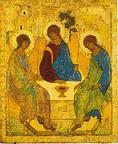
1. The Trinity is not an optional doctrine, it is essential. God’s unity is not behind God’s threeness, God’s unity is in God’s threeness. This is not speculative mathematics, it is a descriptive theology of revelation.

2. The Trinity is not an academic doctrine thought up by clever scholars, rather it grew out of the Christian experience of worship, i.e. it expressed the early church’s pattern of prayer to the Father, through the Son, in the Spirit.

3. The driving force of the development of the doctrine of the Trinity was Christological and soteriological, i.e. it served to articulate the Christian experience of salvation in Christ. The first Christians already knew God; through Jesus they came to know God as Jesus’ Father and Jesus as God’s Son; while in the Spirit Jesus continued to be present to them, forming a family of prayer to the Father and building a community of witness to Christ.

4. The church’s thinking was this: As God discloses himself in worship and salvation, so God must be in Godself. In the technical language of (Karl) Rahner’s Rule: the “economic” Trinity is the “immanent” Trinity, and the “immanent” Trinity is the “economic” Trinity. What you see is what you get, and what you get is what there is.

5. At the heart of the doctrine of the Trinity is God’s being-as-communion. God’s unity is not monadic, it is relational. The doctrine of the Trinity is the church’s exegesis of I John 4:8b: “God is love.” Father, Son and Spirit indwell each other in love, giving, receiving and returning love in an eternal dynamic of gift-exchange.

Read the rest of the Ten HERE.


Second:

~~~~~~~~~~~~~~~~~~~~~~~~~~~~~~~~~~~~~~~~~~~~~~~~~~~~~~~~~~~~~~~~~~~~~~~~~~

Trinitarian reading for laypeople

A friend asked me yesterday about works on the Trinity which could be recommended to interested laypeople who have no theological background. I sent her this list of annotated suggestions – but I’d be interested to know if you have any alternative or additional suggestions:
  • Frederica Mathewes-Green, “The Old Testament Trinity,” in God the Holy Trinity: Reflections on Christian Faith and Practice, ed. Timothy George (Grand Rapids: Baker, 2006), 83-90. [The title might sound dull, but this is a very beautiful little essay, written by the popular Orthodox writer. The essay is a brief meditation on Rublev's great icon of the Trinity.]

  • Cornelius Plantinga, “Deep Wisdom,” in God the Holy Trinity: Reflections on Christian Faith and Practice, ed. Timothy George (Grand Rapids: Baker, 2006), 149-55. [Another chapter from the previous book: a rich and moving homily on the Trinity.]

  • Benedict XVI, “Introduction: An Initial Reflection on the Mystery of Jesus,” in Jesus of Nazareth (New York: Doubleday, 2007), 1-8. [A brief discussion of the Father–Son relation as the central dimension of Jesus’ human existence. The basis of the doctrine of the Trinity lies here, in the humanity of Jesus.]

  • Rowan Williams, “A Man for All Seasons,” Chapter 3 in Tokens of Trust: An Introduction to Christian Belief (Louisville: Westminster John Knox Press, 2007), 57-78. [Like the previous reading, this isn’t strictly focused on the Trinity, but it’s a superb, illuminating, jargon-free account of the relation between Jesus and God – which is the most important thing to grasp when thinking about the Trinity.]

  • Hans Urs von Balthasar, “The Triune Life,” a chapter in Prayer (San Francisco: Ignatius Press, 1986), 177-97. [A moving reflection on the mystery of the Trinity as the heart of ecclesial life.]

  • Vladimir Lossky, Orthodox Theology: An Introduction (Crestwood: St Vladimir’s Seminary Press, 1978), 36-50. [An important and accessible passage from one of the greatest modern Orthodox thinkers, focusing on the relation between the Trinity and human personhood.]

  • Kim Fabricius, “Ten Propositions on the Trinity”. I might seem a bit biased here, but you really can’t go past Kim’s post on the Trinity – it’s concise, profound, beautiful, and best of all true.]

Labels:

hat tip to "Faith and Theology" ... read it HERE.

11 July 2007

Pope Excommunicates King Henry VIII - Coincidence?

I wonder if there is any coincidence that Pope Benedict XVI just made his recent statements about Protestant Churches not really being churches but are "ecclesial communities" (which seems to me to be a dig at both Protestant Churches and the Base Ecclesial Communities that are a key to Liberation Theology) ... AND...on this day in history:

... in 1533, July 11, Pope Clement VII excommunicates England's King Henry VIII for remarrying after his divorce.


Probably just a coincidence...but, who knows...?

CHURCH and Church and church...and...?

The Episcopal Cafe blog quotes an interesting article about the Pope's recent statements about the validity of non Roman Catholic Churches. It seems that he takes a rather hard line about non Roman Catholic churches ... leaving the Eastern Orthodox "wounded" churches, and the Protestant Churches not churches at all... read the article, and the start of some interesting comments here. I know that more people will comment very soon on this topic, and it is not one that is at all a "new" topic, but it does raise for me the difference between the way that "church" is practiced and "done" at the grass-roots level (the local church) as it compares with the church universal. The ways that Christians live out their faith in their own context may look somewhat different than the ways that the Pontiff may discuss his faith and his understanding of faith and practice. I wonder how this document will affect ecumenical work. Will it stymie it? or, will people keep doing the good that they are doing ecumenically no matter what the Pope says?

I need to mull this all over. I took an absolutely great class while in seminary over at Catholic University, taught by a great professor, Rev. Dr. Patrick Granfield. The class was made up of a wide variety of people training for ministry, ELCA, Missouri Synod Lutheran, A.M.E., Episcopal, UCC, Methodist, Roman Catholic. At no time did I feel like "my ministry" or those from other Protestant denominations were "lesser partners" in the mission of the Church. I would hope that this type of thing would be the norm.

Why then does the Pope make this statement, at this time? The answer may be contained in a comment on the Episcopal Cafe site, "Benedict XVI has been pursuing a policy of reconciliation with the Society of St. Pius X, or SSPX for short..." ...interesting!


An excerpt...
Apostolic Succession and the Catholic Church

From today's Arizona Republic

Pope Benedict XVI on Tuesday asserted the spiritual primacy of the Roman Catholic Church.

He did so at the expense of Christian Orthodox churches, which he said are wounded, and Protestant churches, which he said are not really churches at all.

The pope approved a document that says the only path to true salvation is Catholicism. The move was a stark reaffirmation of centuries-old Catholic belief that Protestant churches are lacking because they cannot trace their leadership back to Christ's apostles.

The document says Christian Orthodox churches are true churches but have a "wound" because they do not recognize the power of the pope.