Showing posts with label Trinity. Show all posts

30 May 2021

The Three


The Three

In name of Father,
In name of Son,
In name of Spirit,
Three in One:

Father cherish me,
Son cherish me,
Spirit cherish me,
Three all-kindly.

God make me holy,
Christ make me holy,
Spirit make me holy,
Three all-holy.

Three aid my hope,
Three aid my love,
Three aid mine eye,
And my knee from stumbling,
My knee from stumbling.


Originally from the Carmina Gadelica III, 63
Taken from Esther de Waal, editor, The Celtic Vision 

11 June 2017

11 June 2017 ~ Trinity Sunday Sermon ~ The Rev. Peter M. Carey


The Rev. Peter M. Carey
St. Mary’s, Cathedral Road, Philadelphia
Sermon
Trinity Sunday
11 June 2017


Almighty and Loving God, you live and move and have your being with us and among us and within us always.  Shower your grace upon us, and let us feel your healing presence in our lives always.  You gave us a vision of perfect love and community in the Trinity, allow us to find an entry into the way of Jesus so that we might too live in such a way that your love is communicated through us to the suffering and hurting world.  Be with us, Father, Son, and Holy Spirit.  Amen.


Today we embrace the sense that God is Trinity, three persons, and yet One God.  God as Father, as Son, and as Holy Spirit.  God as Creator, Redeemer, Sanctifier.  Today we embrace the reality that God not only was present to his people in the past, but is present to us today, and will be ever present with us in the future.

The mystery of the Trinity is one that may confound us.  How can something be One, and yet Three.  How can we claim to believe in one God, when it seems we are leaning towards polytheism?  The theological questions are deep, centuries old, and have confounded even the greatest theological minds of the church.  

However, even these confounded qualities of the Trinity are a gift.  While we rely on our logical and rational brains in our day to day world, there are deeper truths  beyond our own thinking.  In our day to day world, we live and move in a dualistic world.  We look at things as either, or, as up and down, as good and evil, as life or death.  However, much of life is not merely either/or, but is both/and.  Our faith moves us deeper.  Jesus leads us into this strange and wonderful existence where we are called to “Love our enemies,” to “pray for those who persecute us” and where even the “poor are blessed” and where “our burdens are light.”  In a few moments at the altar, we will again affirm that even death will not have the final word.  We will affirm that there is even resurrection and life after death.  And so, today, on Trinity Sunday, God confounds us once again by showing us that One is Three and Three is One.

In the earliest centuries of the church, the “movement” of the Trinity was described in Greek by the word: perichoresis.  Peri, meaning “around” - where we get the word perimeter for the distance around a geometrical object.  And then”choresis” - where we get the word choreography, dance, movement.  And so, this movement of the church is an interconnected three-person dance.  As Richard Rohr names his book on the Trinity, “The Divine Dance.”  A loving dance of three persons of the Trinity - three “persons” and yet One God.

And so, what can we glean from this image, how might this mystical and theological image have any relevance to the likes of us?  How might this Trinity Sunday give us something to reflect upon, how might it challenge us, how might is get us to see God, and our lives in a new way, how might it inspire us to get to work in building God’s kingdom?

A model of movement.  Love overflowing.  Other images of the trinity.  Shamrock.  Pouring buckets.   Just as the Trinity has three persons who are interconnected in a holy and loving dance, so to, are we empowered to build loving and interdependent relationships.  God calls us and empowers us to go beyond a static pattern of our lives to a dynamic and robust one.  The interconnected and interdependent Trinity offers us a model of relationship that is also essentially interrelated with others.

One of the clearest and most passionate descriptions of this kind of relationship was described to me by Archbishop Desmond Tutu through his writing and speaking.  I was blessed to have a few occasions where I was able to spend time with him and learn about Ubuntu.

Ubuntu - a relational life - not merely us alone
A person is a person through other persons.
I am, because of you.
Tutu:  “One of the sayings in our country is Ubuntu – the essence of being human. Ubuntu speaks particularly about the fact that you can't exist as a human being in isolation. It speaks about our interconnectedness. You can't be human all by yourself, and when you have this quality – Ubuntu – you are known for your generosity.
We think of ourselves far too frequently as just individuals, separated from one another, whereas you are connected and what you do affects the whole World. When you do well, it spreads out; it is for the whole of humanity.”

When we reflect deeply, we know that our life is fundamentally relational.  Our life is fundamentally dependent upon others.  We are shaped by our family and friends, by our schools, and our workplaces, and by our worshipping communities.  We are each  dependent on others, but also others depend on us.  We need others, and others need us.  

Interdependent.  “I am because of you.”  “A person is a person through other persons.”  This is the joy of God, the grace of God that confounds us, but is a deep truth and a deep gift for us.

Nelson Mandela: “A traveller through a country would stop at a village and he didn't have to ask for food or for water. Once he stops, the people give him food and attend him. That is one aspect of Ubuntu, but it will have various aspects. Ubuntu does not mean that people should not enrich themselves. The question therefore is: Are you going to do so in order to enable the community around you to be able to improve?”

This  image of the Trinity can inspire us to also live and move with the deep knowledge that we are deeply connected to one another.   This Trinity Sunday gives us an image of three persons, but one God, of perichoresis or the “divine dance” of God, which may help us to also reach out and deepen our own connections one to another.  The love of God flows between and among the three persons of the Trinity.  This love is poured out for us, and we are empowered to pass it along, to pay it forward to others. God offers us a confounding and wonderful love.  Healing in the midst of pain, Life in the midst of death, Joy in the midst of sorrow, relationship in the midst of loneliness.  


Holy Trinity, One God, you live and move and have your being with us always.  Shower your love upon us, and let us feel your healing presence so that we may be known by our love for others.  Help us to remember your love always, and the ways that we are connected deeply with one another.  Amen.

17 May 2008

Trinity Sunday

Trinity Sunday

Trinity Sunday

Trinity Sunday

Trinity Sunday

Trinity Sunday

Trinity Sunday

Trinity Sunday

Trinity Sunday

11 January 2008

A 'new' project...Reading the Trinity

Since I finished my seminary studies at VTS last May, and was ordained to the transitional diaconate in June (at Philadelphia Cathedral), and then to the priesthood (at St. James, Richmond), I have been incredibly busy while working in the truly 'incarnational' ministry of school chaplaincy. I have also served as clergy associate at a wonderful church here in Richmond -- St. Mark's Episcopal on the Boulevard. I really love my work, and while there are some real challenges and struggles - internal and external, all in all, I feel blessed having the privilege of serving in this way. Working alongside some truly wonderful people, and having the opportunity to teach, advise, and assist students as they develop and grow is a blessing.

In my spiritual practices, I continue to read the Daily Office - that Anglican Practice of reading the scripture and praying in a mode that goes back to ancient monastic practice. I also lead several services each week - as many as 5-7 a week; and find my prayer life growing deeper and broader through these practices. What I have not done as much since leaving seminary is to read theology.

So, my project (I worry that if I say it is a "resolution," I'll never complete it) is to do some reading and study of the Trinity, and also get further grounding and understanding of Ecclesiology. So, to begin, I ran across these two wonderful blog posts over at the "Faith and Theology" blog. Here I begin to explore the Trinity and also Ecclesiology even more deeply.

First:

~~~~~~~~~~~~~~~~~~~~~~~~~~~~~~~~~~~~~~~~~~~~~~~~~~~~~~~~~~~~~~~~~~~~~~~~~~

Ten propositions on the Trinity

1. The Trinity is not an optional doctrine, it is essential. God’s unity is not behind God’s threeness, God’s unity is in God’s threeness. This is not speculative mathematics, it is a descriptive theology of revelation.

2. The Trinity is not an academic doctrine thought up by clever scholars, rather it grew out of the Christian experience of worship, i.e. it expressed the early church’s pattern of prayer to the Father, through the Son, in the Spirit.

3. The driving force of the development of the doctrine of the Trinity was Christological and soteriological, i.e. it served to articulate the Christian experience of salvation in Christ. The first Christians already knew God; through Jesus they came to know God as Jesus’ Father and Jesus as God’s Son; while in the Spirit Jesus continued to be present to them, forming a family of prayer to the Father and building a community of witness to Christ.

4. The church’s thinking was this: As God discloses himself in worship and salvation, so God must be in Godself. In the technical language of (Karl) Rahner’s Rule: the “economic” Trinity is the “immanent” Trinity, and the “immanent” Trinity is the “economic” Trinity. What you see is what you get, and what you get is what there is.

5. At the heart of the doctrine of the Trinity is God’s being-as-communion. God’s unity is not monadic, it is relational. The doctrine of the Trinity is the church’s exegesis of I John 4:8b: “God is love.” Father, Son and Spirit indwell each other in love, giving, receiving and returning love in an eternal dynamic of gift-exchange.

Read the rest of the Ten HERE.


Second:

~~~~~~~~~~~~~~~~~~~~~~~~~~~~~~~~~~~~~~~~~~~~~~~~~~~~~~~~~~~~~~~~~~~~~~~~~~

Trinitarian reading for laypeople

A friend asked me yesterday about works on the Trinity which could be recommended to interested laypeople who have no theological background. I sent her this list of annotated suggestions – but I’d be interested to know if you have any alternative or additional suggestions:
  • Frederica Mathewes-Green, “The Old Testament Trinity,” in God the Holy Trinity: Reflections on Christian Faith and Practice, ed. Timothy George (Grand Rapids: Baker, 2006), 83-90. [The title might sound dull, but this is a very beautiful little essay, written by the popular Orthodox writer. The essay is a brief meditation on Rublev's great icon of the Trinity.]

  • Cornelius Plantinga, “Deep Wisdom,” in God the Holy Trinity: Reflections on Christian Faith and Practice, ed. Timothy George (Grand Rapids: Baker, 2006), 149-55. [Another chapter from the previous book: a rich and moving homily on the Trinity.]

  • Benedict XVI, “Introduction: An Initial Reflection on the Mystery of Jesus,” in Jesus of Nazareth (New York: Doubleday, 2007), 1-8. [A brief discussion of the Father–Son relation as the central dimension of Jesus’ human existence. The basis of the doctrine of the Trinity lies here, in the humanity of Jesus.]

  • Rowan Williams, “A Man for All Seasons,” Chapter 3 in Tokens of Trust: An Introduction to Christian Belief (Louisville: Westminster John Knox Press, 2007), 57-78. [Like the previous reading, this isn’t strictly focused on the Trinity, but it’s a superb, illuminating, jargon-free account of the relation between Jesus and God – which is the most important thing to grasp when thinking about the Trinity.]

  • Hans Urs von Balthasar, “The Triune Life,” a chapter in Prayer (San Francisco: Ignatius Press, 1986), 177-97. [A moving reflection on the mystery of the Trinity as the heart of ecclesial life.]

  • Vladimir Lossky, Orthodox Theology: An Introduction (Crestwood: St Vladimir’s Seminary Press, 1978), 36-50. [An important and accessible passage from one of the greatest modern Orthodox thinkers, focusing on the relation between the Trinity and human personhood.]

  • Kim Fabricius, “Ten Propositions on the Trinity”. I might seem a bit biased here, but you really can’t go past Kim’s post on the Trinity – it’s concise, profound, beautiful, and best of all true.]

Labels:

hat tip to "Faith and Theology" ... read it HERE.

02 September 2007

"Do not neglect to show hospitality to strangers..."


Sermon – St Mark’s Episcopal, Richmond
Proper 17

Psalm 112; Ecclesiasticus10:7-18; Hebrews 13:1-7; Luke 14:1, 7-14

“Do not neglect to show hospitality to strangers, for by doing that some have entertained angels without knowing it.”

The desert winds whip wildly and the tent gives little shelter. Their wateris running low, and their feeble bodies are suffering with the extreme temperatures. In the daytime, the sun roasts the sand and any living thing feels the suffocating heat. In the night, their animals shiver with cold, and the old man and woman wrap themselves tight. Their journey has brought them out of the land of their birth, away from the gods of their ancestors. This journey has brought them, in their advanced years, to this place. There are a few trees here that have somehow withstood the ravages of the desert. These trees are known as the Oaks of Mamre, and legend tells that their growth and survival depend on divine help. But, in the desert, anything that lives depends on divine help. In the desert, there is a careful dance when coming into contact with others. The prevailing practice is to offer hospitality to those who need it, to offer help, and to extend a hand, water, food, and even shelter. However, there is also an abiding fear that those asking for help may turn violent, and there are many allegiances and alliances to navigate in this land. The man and his wife are traveling in new lands, and are often the ones who need help, and often are the ones to give it – but there exists an abiding risk to this journey, even though God told them to go.

“Do not neglect to show hospitality to strangers, for by doing that some have entertained angels without knowing it.”

Into this camp walk three strangers, asking for food, for water, for hospitality. The old man and his wife give food, water, and offered them shade in the desert heat. The three strangers sit together, and offered thanksgiving for this hospitality, for food, water, and for the place to rest. The three strangers also offer conversation. As they sit together, facing the old man, they asked about his wife, who had returned to the tent cleaning up after she set the table and brought out the bread, the hummus, the grapes and the wine. The three strangers tell the old man that his wife would bear a child. Who were these three strangers? The old woman, hearing the conversation, laughed to herself for she had long ago given up on the thought of children of her own. The conversation continued, and the old woman brought out more food and wine, offering hospitality even as she, too, wondered who these three strangers were. Eventually, the three strangers bid farewell, and offered great thanks to Abraham and Sarah for feeding them, for water, for wine, and for the hospitality in that desert place.

“Do not neglect to show hospitality to strangers, for by doing that some have entertained angels without knowing it.”

This beautiful line from Paul’s letter to the Hebrew refers to that wonderful story in Genesis 18 when Abraham and Sarah encountered three strangers who were actually angels from God. Abraham and Sarah entertained them and showed hospitality to them. This encounter forms one of the key pillars in the Jewish and Christian notion of hospitality for the stranger. Hospitality can get watered down sometimes, if it only pertains to what kind of finger sandwiches or punch is served at a reception. Both Paul and the story in Genesis point to a radicalized form of hospitality. In Hebrews, Paul offers the admonition to show hospitality to strangers – and then names two kinds of strangers that might be offered hospitality: prisoners and those being tortured. Of course it is important to remember the context for this letter. Paul is writing to Christians who are under siege, and some of them have been carried off to prison just for being Christians. To offer hospitality to these prisoners does not mean doing a little prison ministry for an hour a week. Without a visit from a friend, a prisoner would starve, would have no clothes, and could die of thirst. The hospitality given to prisoners by others would offer them the possibility of life. Where this hospitality gets radicalized is that while visiting these strangers, a Christian would put themselves at risk for being jailed as well – the Christians were under siege, and those helping Christian prisoners might be punished. So, when Paul admonishes his listeners to offer hospitality “as if you were prisoners,” this is no metaphor. Paul knows the risks of offering this hospitality, and calls his listeners to this high calling of risky radicalized hospitality.

Likewise for those who are enduring torture. Those Christians who offered hospitality to them would also put themselves at risk for torture. Paul calls his hearers to this high calling of radicalized hospitality because without it, it really is every man for himself, every woman for herself, every child for him or herself. Paul is calling his hearers to this high calling of living as the body of Christ, even though the risks are great. It is in these actions of hospitality that the Body of Christ becomes whole, becomes strengthened. In effect, the church itself is not the building where we go, but in the ways that we bring ourselves to care for and offer hospitality to, one another, and to those strangers, even more importantly. To neglect hospitality is to neglect to see that God calls us to love God, and to love our neighbor as ourselves.

“Do not neglect to show hospitality to strangers, for by doing that some have entertained angels without knowing it.”

It is the calling of every Christian to practice radicalized hospitality. This is not just the calling of the clergy, not just of the Franciscan monks, not just the calling of the do-gooder types. Offering radical hospitality to the stranger is a calling for all of us. In the early church, it was the role of the deacon to help turn the eyes, ears and hearts of the Church to the needs of the world. In particular, deacons offered hospitality to those who were poor, in prison, and in need. The deacon did not to do this work on his or her own, but worked to inspire those in the to work to respond to the cries of a world in need.

And so, as a deacon I want to raise questions that emerge from radicalized hospitality in our present context: (1) How would radicalized hospitality affect our discussions about immigration reform? Could this theology help move the discussion to a different level? (2) How might radicalized hospitality help the current discussions and debates in the Anglican communion? Could our hearts be open wide enough to hear those with whom we vehemently disagree? (3) Could radicalized hospitality help us to engage more productively with people from other faith traditions? Perhaps our common heritage from the dry deserts of the Middle East may offer a beginning point.

I don’t know the answers to these questions … but I raise them as a deacon in this pulpit.

An early deacon was St. Stephen, who served the church in this way, and suffered the fate of many Christians when he was martyred, perhaps under Saul’s supervision. Some people claim that St. Francis was a deacon, and even if he wasn’t, he still embodied that diaconal ministry of service, of radicalized hospitality as he lived with and cared for lepers and the poor and the outcast. St. Francis, even as he suffered the pains of “lady poverty” he also lived a life of joy. Joy is what this radicalized hospitality should be all about – not solely drudgery or guilt-induced service. No! Paul reminds us of the promise of living this type of hospitality,

“Do not neglect to show hospitality to strangers, for by doing that some have entertained angels without knowing it.”

The Good News is that this hospitality is no project of our own, this hospitality is no human invention. God gives us the gifts to open up our hearts to those strangers in our midst, and those strangers all around us. I think we’ve all experienced the ways that turning to others in need cultivates a joy that is deep and abiding, we may “have entertained angels without knowing it”!

The Church exists most boldly and most fully in the sharing of hospitality between people, this is where we experience Christ. God gives us the power to create that space where love for neighbor is cultivated, enabled, and modeled. God gives us the gift of bringing people together in order support one another. There is a saying of the desert monastic, John the Dwarf, which illustrates this point quite well:

“You don’t build a house by starting with the
roof and working down. You start with the
foundation."
They said, “What does that mean?”
He said, “The foundation is our neighbor
who we must win. The neighbor is where
we start. Every commandment of Christ
depends on this.”

The goal in this life is to build up one another and to work with diligence to bring one’s neighbor to Christ. The church is built on our cultivation of radicalized hospitality of care and love to neighbor, and to stranger. God sets a high calling before each of us, but, God is with us, and God gives us the gifts to open up our hearts to those strangers in our midst, and those strangers all around us.

“Do not neglect to show hospitality to strangers, for by doing that some have entertained angels without knowing it.”

Rev. Peter M. Carey

08 August 2007

Rev. Dr. Michael Battle on Ubuntu


Well, lots of posting today...I am avoiding unpacking and enjoying the surfing...also, it is HOT HOT HOT down here in Richmond, VA...


Here is a video clip of my thesis advisor and professor from seminary, the Rev. Dr. Michael Battle who gives a very short (1min 29seconds) description of the African theology of Ubuntu, the idea that "a person is a person through other persons." He's a wonderful person and I feel blessed to have had the chance to learn (a bit) of his wisdom over my years in seminary. He is now the Provost of the Los Angeles Cathedral. Check it out, it's pretty good...

Click HERE, to see the video clip, (posted on the Episcopal Cafe blog)...

26 June 2007

Check out Laura's Blog: My Quotidian Mysteries !!!


After doing a little surfing around on Facebook, I realized that my colleague from Seminary, Laura, has a wonderful blog called My Quotidian Mysteries which is just excellent and wonderful. You can see the first post in her blog here. She has a deep sense of God's work in the everyday, and her blog reflects this sensibility.


Quotidian - (adj.) everyday, ordinary, commonplace
the space where mothers often dwell and out of which great mysteries emerge


Here is her first post (from April, 2007) for a little taste of her reflections:

"Two months after my daughter was born, I read a terrific book by Kathleen Norris entitled "The Quotidian Mysteries." In it she argues that the hum-drum aspects of life are avenues into the incarnational reality of Christ. Laundry can be a spiritual discipline if you have the eyes to see it. I've been lurking in "mommy blogs" lately, and I've been really impressed with the women that write them who are living faithful, often uncelebrated lives. These are my quotidian sisters, and this blog is one more contribution to the quotidian mysteries of which we partake: nap schedules, food preparation, laundry, lonely times, confusing times, joyful times; developmental milestones and setbacks; marriage ups and downs. I loaned the book to a friend on Tuesday who loved it and loaned her copy to someone else. She needed another read. Hopefully I'll see it again. In the meantime, I'll press on with today's mysteries."


Do check out her blog, Laura is great, and this blog is also quite wonderful. She is headed to Qatar with her husband (who works for the State Department) and young daughter. I imagine her reflections and thoughts will become even deeper and broader in coming weeks and months.

My Quotidian Mysteries Blog
at http://myquotidianmysteries.blogspot.com/

05 June 2007

Trinity Sunday (just a few days late)


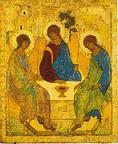
This last Sunday was Trinity Sunday, on which we celebrate our Christian belief that God is 3 in 1, 1 in 3. The icon above is a depiction of the Russian artist Rublev's depiction of the 3 visitors to Abraham (Genesis 21), which is now referred to as Rublev's Holy Trinity Icon.

With my family, we went to the childrens' service at at St. Columba's in Washington, DC this Sunday and heard a wonderful and amazingly understandable description of the Trinity from the Rev. Martin Smith (former Superior of SSJE, and Chaplain to the House of Bishops):

To the childrens' service, he said this at the dismissal:

"Remember that today's service was brought to you by the number 3.
One - Who created us;
Two - Who saved us;
and Three - Who is with us always."

After much examination of the theology of the Trinity this year on my thesis and in the Ecclesiology of Communion Blog, this description kicks my own efforts in the backside! It was excellent, simple and grounded in the history of the tradition. Kudos to Martin Smith.